Best 8,000 BTU Window Air Conditioners: Top 9 Picks (November 2026)
The best 8,000 BTU window air conditioners include the GE Window Air Conditioner 8000 BTU for most medium rooms, the Midea 8 for year-round use, and the DELLA 8000 BTU Energy Saving Window Air for low energy bills.
On this page (8 sections)
- The best 8,000 BTU window air conditioners, ranked by score
- How these 8,000 BTU window air conditioners compare
- How we compared these window units
- Which room size does an 8,000 BTU unit actually cool?
- Do you need a heat pump in a window unit?
- How much noise will you notice?
- What should you check before you order?
- Verdict: the best 8000 BTU window air conditioner for your window
The best 8,000 BTU window air conditioner for most rooms is the GE Window Air Conditioner 8000 BTU, because it cools up to 350 sq ft and adds app, voice and eco controls in a 50 lb cabinet. If you also need heat in fall, the Midea 8 is the pick; for simple quiet cooling, look at the LG 8,000 BTU.
Size is the first decision, not brand. An 8,000 BTU unit is built for a medium room of about 300 to 350 sq ft, and this range is the most common choice for a living room, family room or large bedroom.
Nearly every model in this group carries the same 350 sq ft rating, so the real differences come down to controls, cabinet depth, window fit and how much noise you'll tolerate next to a sofa or a bed.
If you're still working out the math, our guide on how to choose a window air conditioner walks through square footage, sun exposure and window type. When the room is smaller, our roundup of the best window air conditioners for a bedroom covers quieter, lower-capacity options.
Our picks at a glance
-
1

-
2

-
3

- 4
 Best for small bedroomsCheck it
- 5
 Check it
GE 5,000 BTU window air conditioner
Best for tight windows - 6
 Check it
LG 8,000 BTU window air conditioner
Best for straightforward cooling - 7
 Best for quiet bedroomsCheck it
- 8
 Check it
ROVSUN 8,000 BTU window air conditioner with heat
Best for guest rooms - 9
 Check it
BLACK+DECKER Window Air Conditioner 8000 BTU
Best for basic remote control
The best 8,000 BTU window air conditioners, ranked by score
The GE leads on a mix of smart control, efficiency and a 350 sq ft rating, and the others each win on a specific need. Read down the list for the one that matches your window and your room.
Three units here lean on a remote and a plain control panel instead of smart features, so if you don't want another app in your life, those are worth a closer look.
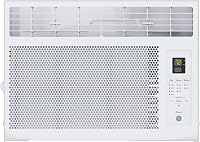
GE Window Air Conditioner 8000 BTU: Best for most medium rooms
- Cools up to 350 sq ft
- SmartHQ app plus Alexa and Google Assistant
- Eco mode
- Slides into double hung windows 24.5 to 36 in wide
Smart controls, an eco mode and a 350 sq ft rating make this the easy default for a living room or family room.
Pros
- App and voice control
- Eco mode turns off fan and compressor
- Washable filter slides out
Cons
- Heavier than several rivals here
- Needs a double hung window
The GE is the best 8,000 BTU window air conditioner for a living room or family room because it hits the two things most buyers need at once: 350 sq ft of cooling and full smart control. You can set a schedule in the SmartHQ app, or ask Alexa or Google Assistant to change the temperature.
The unit is rated at 0.7 tons with a rotary scroll compressor, and the controls cover three cooling modes and three fan speeds so you can match airflow to the room.
In daily use, Eco Mode is the feature you'll notice most. When the room reaches the set temperature, it turns off both the fan and the compressor, which is where the savings come from on a unit that runs all afternoon.
A 24-hour on/off timer and a power interruption restart round out the convenience features.
The cabinet is fixed and slides into a double hung window from 24.5 to 36 in wide, with a minimum 13.375 in height. At 50 lb it's heavier than the DELLA, so plan for a second pair of hands at install.
The washable filter slides out for cleaning every 30 days.
Its trade-off is noise: 52 dB is fine for a living room but a little louder than the Midea for a bedroom. If a quiet bedroom is the goal, jump to the Midea or the LG below.
Midea 8: Best for year-round use
- Cooling plus a heat pump for outside temps above 41 F
- Inverter compressor
- As low as 45 dBA
- Energy Star rated
A heat pump and inverter compressor let one unit cool a bedroom all summer and take the chill off in fall.
Pros
- Supplemental heat for fall
- Inverter compressor
- Very quiet at low fan
Cons
- Heat stops working below 41 F outside
- Deeper cabinet at 22.17 in
The Midea 8 is the pick when you want one unit to handle more than summer. It's an 8,000 BTU air conditioner with a heat pump, so it cools and dehumidifies in July and adds supplemental heat in fall, with one limit: the heat function only works when the outside temperature is above 41 F.
The five modes cover Heat, Auto, Cool, Dry and Fan, and three speeds with a swing button move the louvers up and down to direct airflow.
The inverter compressor is the bigger story for running costs. Midea says variable-speed operation saves up to 35% against the Energy Conservation Standard, and the unit is Energy Star rated.
Annual energy consumption is listed at 407 kWh per year, and the app plus Alexa or Google Assistant gives you the same remote control options as the GE.
Quiet operation matters if the window is near a sofa or a bed: it runs as low as 45 dBA, the quietest in this group. The washable filter is reached from the front panel, so maintenance doesn't mean pulling the unit.
The trade-off is depth. At 22.17 in deep it sits further into the room than the GE or the LG, and it suits windows from 24 to 38.5 in wide with a 14.5 in vertical opening.
If you'd rather see more heat-and-cool options, our roundup of the best window air conditioner with heat covers the range.
DELLA 8000 BTU Energy Saving Window Air: Best for low energy bills
- CEER of 10.9
- Della+ app plus Alexa and Google Assistant
- 44.8 lb unit
- Fits windows 23 to 36 in wide
High efficiency numbers and a light cabinet make this a practical pick for a bedroom or office window.
Pros
- CEER of 10.9
- Light at 44.8 lb
- App and voice control
Cons
- No inverter compressor
- Loudest of the top three here
Della aims this unit at buyers who watch the electric bill. Its CEER of 10.9 is a strong efficiency number for an 8,000 BTU window unit, and it carries a UL listing.
It runs on 115V at 60Hz and its 8,000 BTU rating matches the 350 sq ft ceiling the rest of this group shares.
The cabinet is the lightest of the top three at 44.8 lb, which makes a solo install more realistic on a second-floor window. It's also the most compact of the 8,000 BTU units here at 17.05 in deep and 18.58 in wide.
It fits windows from 23 to 36 in wide with a 14.5 in minimum height, so it slips into narrower frames than the Midea.
For control, you get the Della+ app, Alexa and Google Assistant, plus a remote and an LED panel with a 61 F to 88 F range. Sleep mode and eco mode are both there for overnight use, along with a 24-hour timer and four modes (Auto, Cool, Fan, Dry).
The app also supports geo location, so it can react when you head home.
The trade-off against the GE and the Midea is noise and compressor type. At 54 dB it's the loudest of the top three, and it uses a standard compressor rather than an inverter, so it cycles rather than ramps.
That matters more in a bedroom than in an office you leave during the day.
Midea 6: Best for small bedrooms
- Cools up to 250 sq ft
- Three-speed fan and dehumidifier mode
- Remote control included
- Fits windows 23 to 36 in wide
A smaller unit for a compact bedroom where 8,000 BTU would cycle on and off too fast.
Pros
- Right size for 250 sq ft
- Dehumidifier mode
- Eco mode and 24-hour timer
Cons
- Only 6,000 BTU
- No Wi-Fi
The Midea 6 is the right answer when the room is smaller than 350 sq ft. It's a 6,000 BTU unit rated for 250 sq ft, which means longer, steadier run cycles in a compact bedroom instead of the short bursts an oversized 8,000 BTU unit would give you.
The cabinet is small too, at 13.19 in deep and 15.98 in wide, and it weighs 38.2 lb.
Three modes cover the basics: cool, a three-speed fan, and a dehumidifier mode for damp stretches. It runs as low as 52 dB and comes with a remote, plus EcoSave and SleepWell modes and an EasyTimer you can program up to 24 hours ahead.
Auto restart brings the unit back with your last settings after a power cut, and a Clean Filter warning tells you when the washable filter needs a rinse.
Installation is the simple part. It fits windows from 23 to 36 in wide with a 14 in vertical opening, and all mounting hardware is included, though you'll need your own screwdriver.
It's rated at an efficiency of 11.
The trade-off is capacity. It's sized for a single compact room, and it has no Wi-Fi or app control.
Use it where the room is small and the remote is enough. The Midea warranty covers one year on parts and labor.
GE 5,000 BTU window air conditioner: Best for tight windows
- Cools up to 150 sq ft
- Mechanical dials, no app
- Fits windows 27.125 to 36 in wide
- 52 dBA on low
Simple dial controls and a narrow cabinet suit a dorm, office or small spare bedroom.
Pros
- No app or Wi-Fi needed
- Fits narrow double hung windows
- 440W power draw
Cons
- Only 5,000 BTU
- Manual controls only
The GE 5,000 BTU is here because not every window takes an 8,000 BTU cabinet. It's rated for 150 sq ft, so it suits a dorm room, a home office or a small spare bedroom, and its fixed chassis fits double hung windows from 27.125 to 36 in wide.
The compact cabinet measures 16.4 in wide, 13.4 in deep and 12.6 in high.
Mechanical dials are the appeal. There's no app, no Wi-Fi and no digital beeps: 10 temperature settings, two cooling modes and two fan speeds, with low at 52 dBA for nighttime and high at 56 dBA when you want to cool fast.
The auto restart feature picks your settings back up after a power cut.
It draws 440W, which is low for a window unit, and the washable filter means no replacement parts to buy. Its air flow efficiency is listed at 143 cubic feet per minute per watt.
Installation needs no professional help, and the EZ Mount kit includes foam insulation to seal the frame.
The trade-off is obvious: it won't cool a medium room, and it has no remote. Choose it when the room is genuinely small or the window is narrow.
It carries a one-year GE limited warranty.
LG 8,000 BTU window air conditioner: Best for straightforward cooling
- Cools up to 350 sq ft
- 3 cooling and fan speeds plus Auto Cool
- 53 dB on low
- Auto restart after outages
A plain remote-controlled unit with four-way airflow and no smart extras to set up.
Pros
- Quiet at 53 dB
- Four-way air deflection
- Auto restart
Cons
- No app or voice control
- No heat function
The LG is the pick for buyers who want cooling and nothing more. It's an 8,000 BTU unit for up to 350 sq ft, roughly a 14 by 25 ft room, with three cooling and fan speeds plus Auto Cool to match fan speed to the room.
A 24-hour timer lets you build a schedule.
It's quiet at 53 dB on low, and the four-way air deflection lets you point the airflow at a seating area rather than straight across the room. Auto restart brings it back after an outage, and a filter light reminder handles maintenance.
The washable filter pulls out for cleaning.
There's no app and no voice control. If you'd rather set it once on the remote and forget it, that's a feature rather than a gap.
The cabinet measures 19.38 in deep and 19.57 in wide, so it needs a little more sill space than the GE.
The trade-off against the GE is smart control. You give up the SmartHQ app and eco scheduling for a simpler, quieter unit with a lower score on features.
It's the better pick if the window is near a bed and you never plan to use an app.
Frigidaire 8: Best for quiet bedrooms
- Cools up to 350 sq ft
- 6-way directional airflow
- Sleep mode raises the temperature overnight
- 54 dBA
Sleep mode and six-way airflow aim this unit at bedrooms and small living rooms.
Pros
- Sleep mode for overnight
- Clean filter alert
- 24-hour timer
Cons
- No Wi-Fi
- 54 dBA is mid-pack here
Frigidaire points this unit at bedrooms. Sleep mode gradually raises the set temperature overnight, which keeps the room from getting cold as you sleep, and Clean Filter alerts tell you when the washable filter needs a rinse.
The 24-hour timer lets you match the schedule to your day.
Cooling is rated for 350 sq ft, with six-way directional airflow and three fan speeds. Dry Mode pulls excess moisture out of the air, and Eco Mode saves energy while holding a comfortable temperature.
The unit runs on 115V at 720W.
At 54 dBA it sits mid-pack on noise, so it's better suited to a small living room or a bedroom where a little white noise is welcome. Its efficiency rating is 10.9 and annual energy consumption is listed at 550 kWh per year.
The trade-off is extras. There's no Wi-Fi or app control, and its cabinet is the narrowest of the 8,000 BTU group at 15.8 in wide and 18.5 in deep, which can matter in a tight frame.
It's a sensible choice when sleep comfort matters more than remote features.
ROVSUN 8,000 BTU window air conditioner with heat: Best for guest rooms
- 8,000 BTU cooling plus 4,000 BTU heat
- App and Alexa or Google control
- 5 modes including Dry
- Fits windows 26 to 36 in wide
A budget heat-and-cool unit for a spare room that sits empty in spring and fall.
Pros
- Heat and cool in one cabinet
- App and voice control
- Washable filter at the front panel
Cons
- Loudest unit here at 57 dB
- Window opening needs 16 in height
ROVSUN offers a heat-and-cool unit for a guest room or a seasonal cabin. It does 8,000 BTU of cooling and 4,000 BTU of heat, with five modes (Heat, Auto, Cool, Dry, Fan) and a washable filter at the front panel.
Three speeds plus Auto let you dial the airflow down at night.
App and voice control work through Alexa or Google Assistant, so you can warm the room before you arrive. The 24-hour timer and eco mode are there for the weeks when nobody's home.
The touch panel, remote and app all reach the same five modes and the swing function.
Installation needs more window height than the others: it fits windows 26 to 36 in wide with a 16 in opening, so measure the sash before you commit. The cabinet is also the deepest here at 24.02 in.
The trade-off against the Midea 8 is noise and heat output. At 57 dB it's the loudest unit here, and 4,000 BTU of heat is supplemental rather than a full winter solution.
It makes sense where a heat pump is out of budget and the room only needs a seasonal lift.
BLACK+DECKER Window Air Conditioner 8000 BTU: Best for basic remote control
- Cools up to 350 sq ft
- Full function remote
- Sleep and energy saver modes
- Fits windows 23 to 36 in wide
A no-frills unit with every setting on the remote and a cabinet that fits common window widths.
Pros
- Remote runs every function
- Fits 23 in windows
- R32 refrigerant
Cons
- No app control
- Fewest extras in this group
BLACK+DECKER keeps it simple. This 8,000 BTU unit cools up to 350 sq ft and puts every setting on a full function remote: sleep mode, energy saver and a 24-hour timer are all a button away.
The digital display and electronic control panel on the unit reach the same settings if the remote goes missing.
The accordion side panels help it fit standard double hung windows from 23 to 36 in wide, with a 15.5 in minimum height. It uses R32 refrigerant, which BLACK+DECKER notes has zero impact on the ozone layer.
Its 10.9 CEER matches the DELLA and Frigidaire, and annual energy consumption is listed at 527 kWh per year.
Cooling runs at four levels: auto, low, medium and high, with a 62 F to 86 F thermostat. The unit weighs 47 lb and measures 15.75 in deep and 18.5 in wide.
The trade-off is features. There's no app or voice control, and its score of 8 is the lowest here because the other units add either a heat pump, Wi-Fi or a quieter cabinet.
Choose it when the remote is the whole interface you want and the price tier is the draw.
How these 8,000 BTU window air conditioners compare
The GE wins on the mix of features, the Midea on season length, and the DELLA and LG on efficiency and simplicity. The table lines up the specs that decide the choice.
Pay attention to the noise column first if the unit goes near a bed, then the window fit, then the control type.
| Product | Best for | Cooling power | Room size | Noise | Our score |
|---|---|---|---|---|---|
| GE Window Air Conditioner 8000 BTU | most medium rooms | 8,000 BTU | Up to 350 sq ft | 52 dB | 9.7 |
| Midea 8 | year-round use | 8,000 BTU | Up to 350 sq ft | As low as 45 dBA | 9.6 |
| DELLA 8000 BTU Energy Saving Window Air | low energy bills | 8,000 BTU | Up to 350 sq ft | 54 dB | 9.3 |
| Midea 6 | small bedrooms | 6,000 BTU | Up to 250 sq ft | As low as 52 dB | 8.6 |
| GE 5,000 BTU window air conditioner | tight windows | 5,000 BTU | Up to 150 sq ft | 52 dBA low, 56 dBA high | 8.5 |
| LG 8,000 BTU window air conditioner | straightforward cooling | 8,000 BTU | Up to 350 sq ft | As low as 53 dB | 8.5 |
| Frigidaire 8 | quiet bedrooms | 8,000 BTU | Up to 350 sq ft | 54 dBA | 8.4 |
| ROVSUN 8,000 BTU window air conditioner with heat | guest rooms | 8,000 BTU | Up to 350 sq ft | 57 dB | 8.1 |
| BLACK+DECKER Window Air Conditioner 8000 BTU | basic remote control | 8,000 BTU | Up to 350 sq ft | 8.0 |
Our score weighs specs, features and how well each unit fits what a buyer searching for an 8,000 BTU window air conditioner needs: cooling capacity for a medium room, control options, noise and efficiency. A unit with a heat pump earns credit for year-round use, while a plain unit earns credit for being easy to live with.
How we compared these window units
We compared the specs: cooling capacity and rated room size, control methods, noise levels, energy ratings and window fit. Features that affect daily use, like eco modes, timers and washable filters, carried weight over extras you'd rarely touch.
We didn't test these units in a lab. The scoring reflects the specs each brand publishes and how those numbers match a medium room.
That's why noise ratings and fit ranges come from the manufacturer rather than from measurements here.
Which room size does an 8,000 BTU unit actually cool?
An 8,000 BTU window air conditioner cools about 300 to 350 sq ft, which is a medium living room or a large bedroom. Use that as the starting point, then adjust for the room.
When to size up or down
Size up if the room has high ceilings, a wall of west-facing glass, or an open doorway to a hallway. Heat gain from those sources can push a 300 sq ft room toward a larger unit.
Size down if the room is under 250 sq ft. A smaller 6,000 BTU unit will run longer cycles and hold a steadier temperature than an 8,000 BTU unit that shuts off early.
The Midea 6 at 250 sq ft is the example to keep in mind for a compact bedroom.
What the tonnage rating tells you
Most 8,000 BTU units here are rated around 0.67 to 0.7 tons. That's the same capacity expressed a different way, so a tonnage figure won't make one model look stronger than another.
Match the tonnage to the square footage and move on to the features.
Do you need a heat pump in a window unit?
A heat pump is worth it if you use the room in spring and fall and want supplemental warmth without a separate heater. The Midea 8 is the strongest example here.
The ROVSUN is the budget alternative, with 4,000 BTU of heat instead of a full inverter heat pump.
Heat pump limits to know
Heat pumps lose output as the outside air gets cold. Midea states the heat function works only when the outside temperature is above 41 F, so it extends the shoulder seasons rather than replacing a furnace.
If that's what you need, it's a real gain for one cabinet. If you need heat in deep winter, plan on a separate heater and treat the window unit as cooling first.
How much noise will you notice?
Expect 45 to 57 dB across this group, and choose the low end for a bedroom. The Midea runs as low as 45 dBA and the LG and GE sit at 52 to 53 dB.
The GE 5,000 BTU lists 52 dBA on low and 56 dBA on high, so even the small unit is not silent at full tilt.
Matching noise to the room
For a living room, anything under 55 dB is fine. For a bedroom, look at the low-fan rating rather than the high one, because that's the setting you'll sleep on.
The ROVSUN at 57 dB is a guest-room unit, not a bedside one. A unit that runs a longer, slower cycle at a lower fan speed often feels quieter in practice than its rating suggests, which is another reason not to oversize for a small bedroom.
What should you check before you order?
Measure the window opening, not just the room, because the cabinet has to fit. Check the clear width and the vertical sash opening against the unit's fit range.
A cabinet that is an inch too wide will not seat, and no mounting kit fixes that.
Window fit, power and the install kit
Most units here suit double hung windows 23 to 36 in wide, with 13.4 to 16 in of vertical opening. Midea needs up to 38.5 in width and ROVSUN needs 16 in of height, so those are the exceptions.
The GE 5,000 BTU starts at 27.125 in wide, which means it will not fit the narrowest frames even though it's the smallest unit.
Every model runs on a standard 115V outlet and includes a mounting kit. A fixed chassis slides in once, which is easier to seal than a unit you pull out each season.
Leave a dedicated outlet free if you can, and check the circuit before you plug in a second appliance on the same line.
Smart controls versus a plain remote
The GE, Midea 8, DELLA and ROVSUN all offer app and voice control. The LG, Frigidaire and BLACK+DECKER stick to a remote and a panel.
If you want to cool the room before you get home, the app group is the one to shop. If you'd rather not deal with Wi-Fi setup, the remote group is simpler and no less capable at the basics.
Verdict: the best 8000 BTU window air conditioner for your window
Pick the GE Window Air Conditioner 8000 BTU if you want the best all-round 8,000 BTU window unit for a medium room, with smart control and an eco mode that saves on long summer afternoons. Choose the Midea 8 if the room needs heat in fall, the DELLA if efficiency is the priority, and the LG if you want quiet cooling and nothing to set up.
For a compact bedroom under 250 sq ft, the Midea 6 is the better size, and the GE 5,000 BTU covers small or narrow-window rooms. The Frigidaire suits a sleeper who wants sleep mode and airflow control, while the ROVSUN and BLACK+DECKER fill the budget end.
Start with the room's square footage, check the window fit, then let the controls you'll actually use decide the rest.
Our top 3 picks at a glance
-
1
-
2
-
3
Frequently asked questions
What size room does an 8,000 BTU window air conditioner cool?
An 8,000 BTU window unit cools a room of about 300 to 350 sq ft under normal conditions. High ceilings, a sunny west wall or an open doorway to the rest of the house can make a room feel bigger than that, so size up if any apply.
Is 8,000 BTU too much for a bedroom?
It can be. An 8,000 BTU unit in a small bedroom short-cycles: it cools fast, shuts off, then starts again, which feels clammy.
If your bedroom is under 250 sq ft, a 6,000 BTU unit runs longer cycles and holds a steadier temperature.
Does an 8,000 BTU window AC use a lot of electricity?
Expect roughly 660 to 720 W while the compressor runs on most 8,000 BTU models. Over a summer that adds up, so efficiency numbers matter.
Look for a CEER of about 10.9 or higher, and use eco or sleep mode for overnight running.
Can I put an 8,000 BTU window unit in a sliding window?
No, not with the kits these units come with. All the picks here install in a double hung window, with a vertical sash that opens.
A sliding window needs a special bracket or a through-the-wall sleeve, so measure the frame before you choose a model.
How wide does my window need to be for these units?
Most 8,000 BTU window units fit double hung windows from about 23 to 36 in wide, with a vertical opening of 13.4 to 16 in. Measure the clear opening and the sash height before ordering, because a cabinet that is a half inch too wide will not seat in the frame.