9 Best Energy Efficient Window Air Conditioners (November 2026)
The best energy efficient window air conditioners include the GE Window Air Conditioner 8000 BTU for most medium rooms, the Midea U for the lowest running costs, and the Electactic Window Air Conditioner 10 for straightforward cooling on a budget.
On this page (7 sections)
- Best energy efficient window air conditioners, ranked
- How these energy efficient window ACs compare
- How we compared these window air conditioners
- Which window AC size fits your room?
- Inverter vs standard compressor: which saves more?
- What energy-saving features actually help?
- Which efficient window AC suits your room?
The best energy efficient window air conditioner for most rooms is the GE Window Air Conditioner 8000 BTU, which pairs Eco Mode with app scheduling for spaces up to 350 sq ft. For the lowest running costs in a larger room, the Midea U inverter unit is the pick.
The Midea 7,800 BTU is the best quiet pick sized for a bedroom.
Efficiency in a window AC comes down to two things: how many BTU the unit delivers per watt, and how well its controls stop it from cooling an empty room. An inverter compressor and a smart thermostat do more for your power bill than the label alone.
This guide ranks the best energy efficient window air conditioners by both. We compared published efficiency ratings, BTU coverage, noise figures and smart controls against what each unit is actually good at, then placed each one where it fits best.
If you're still weighing basics like window size and BTU, start with our guide on how to choose a window air conditioner.
Our picks at a glance
-
1

-
2

-
3
 Best for straightforward cooling on a budget
Electactic Window Air Conditioner 10
9.2/10 our score
See it on Amazon
- 4
 Check it
Frigidaire 5,000 BTU window air conditioner
Best for small bedrooms - 5
 Check it
LG 8,000 BTU window air conditioner
Best for simple remote control - 6
 Check it
LG 6,000 BTU window air conditioner
Best for a den or home office - 7
 Best for a quiet bedroomCheck it
- 8
 Check it
TCL 10,000 BTU smart window air conditioner
Best for app and voice control - 9
 Check it
GE 6,000 BTU electronic window air conditioner (earlier model)
Best for guest rooms and studios
Best energy efficient window air conditioners, ranked
The GE 8,000 BTU leads because Eco Mode, app scheduling and three fan speeds keep it from running flat out. The Midea U ties it on pure efficiency, and the rest of the list covers smaller rooms, tighter budgets and smart-control needs.
Every unit here earns its place on a specific job. Read each entry for the room it suits before you shortlist.
The units split cleanly into inverter models, which vary their speed to hold a temperature, and standard-compressor models, which switch on and off. That one difference shapes running cost, noise and how even the cooling feels.
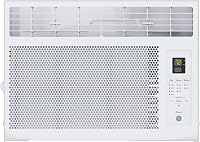
GE Window Air Conditioner 8000 BTU: Best for most medium rooms
- 8,000 BTU for rooms up to 350 sq ft
- Eco Mode shuts off fan and compressor
- Wi-Fi with SmartHQ app, Alexa and Google Assistant
- 52 dB rated noise
Eco Mode and app scheduling keep this 8,000 BTU unit from cooling an empty room. It fits standard double-hung windows without extra hardware.
Pros
- Eco Mode saves energy automatically
- Wi-Fi control and voice assistants
- Washable slide-out filter
Cons
- 52 dB is louder than inverter rivals here
- Fixed chassis is heavier to lift into place
This GE is the easiest efficient choice for a living room or family room up to 350 sq ft. Its Eco Mode turns off the fan and compressor once the room hits your set temperature, then starts again when it warms, so you're not paying to cool a room that's already comfortable.
The SmartHQ app lets you set a schedule and check the unit remotely, and it works with Alexa and Google Assistant. That matters for energy use because you can turn it off when nobody's home instead of leaving it running all afternoon.
A 24-hour on/off timer and power interruption restart do the same job for people who skip the app.
Three cooling modes and three fan speeds let you run the fan low at night to cut draw. The 52 dB rating is a step behind the inverter units here, so it's better in a living area than beside your bed.
It installs in a double-hung window 24.5 to 36 in wide and 13.375 in high with the included EZ Mount kit. The fixed chassis means you lift the whole 50-pound unit in at once.
Pick it for the best mix of efficient operation and smart control.
Midea U: Best for the lowest running costs
- 10,000 BTU for rooms up to 450 sq ft
- DC inverter rated over 37% energy savings
- ENERGY STAR certified
- Noise as low as 32 dBA
The U-shaped inverter unit blocks outside noise and runs on far less electricity than a standard compressor. The open window keeps your view.
Pros
- Inverter saves more energy than any other pick here
- Quietest operation at 32 dBA
- Window still opens for fresh air
Cons
- Premium price tier for the size
- Quick-snap bracket install takes more care than a slide-in kit
The Midea U is the most efficient unit here and the best fit for a large room you cool all summer. Its DC inverter compressor is rated at over 37% energy savings against traditional units, and Midea says it's the first window AC to carry ENERGY STAR certification.
An efficiency rating of 15 puts it well above the standard-compressor picks. Over a full season in a 450 sq ft room, that gap in watts adds up to real money.
The U-shape uses your window to block outside noise, and Midea rates operation as low as 32 dBA. The window can also open while it's installed, so you keep fresh air and most of your view, and an anti-theft mechanism locks it when closed.
It costs more upfront than the Electactic or TCL units at the same square footage. The inverter earns that back if you run it hard.
Fit is a single- or double-hung window 22 to 36 in wide and at least 13.75 in high. Pick it when running cost matters more than the sticker price.
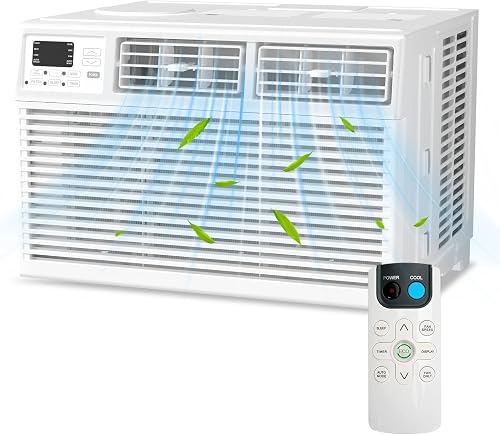
Electactic Window Air Conditioner 10: Best for straightforward cooling on a budget
- 10,000 BTU for rooms up to 450 sq ft
- 10.9 CEER efficiency rating
- Sleep, Auto and Eco modes
- Programmable 0.5 to 24 hour timer
A standard-compressor 10,000 BTU unit with Eco and Sleep modes and a full timer. It covers the same square footage as the Midea U for less money.
Pros
- Covers 450 sq ft
- Full 0.5 to 24 hour timer
- Automatic resume after a power cut
Cons
- No inverter, so it draws more power than the Midea U
- Remote only, with no app or voice control
Electactic covers the same 450 sq ft as the Midea U for less money upfront. Its 10.9 CEER rating is solid for a standard-compressor unit, and Eco and Sleep modes help it run efficiently when you're not asking for full cooling.
The programmable timer runs from 0.5 to 24 hours, so you can set it to shut off overnight or before you leave for work. Auto resume returns to your settings after a power cut, which saves you from re-programming it after a storm.
It uses a remote only, with no app or voice control. If you want to turn the AC on from the office, this isn't the unit for you.
The washable filter has a reminder light so it stays clean and efficient.
The trade-off against the Midea U is running cost: no inverter means more power draw over long hours. Pick Electactic if the lower upfront cost matters more than the lowest possible bill.
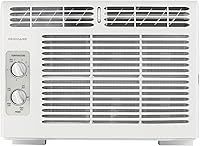
Frigidaire 5,000 BTU window air conditioner: Best for small bedrooms
- 5,000 BTU for rooms up to 150 sq ft
- Efficiency rating of 11
- Quiet 52 dBA operation
- Auto Restart and washable filter
A small, efficient unit for a single bedroom or home office. Low wattage and two fan speeds keep electricity use modest for the room size.
Pros
- Efficient 11 rating for a small unit
- Quiet at 52 dBA
- Extra-long three-prong cord
Cons
- Only cools up to 150 sq ft
- No remote in the box
Frigidaire is the efficient pick for a single bedroom or home office up to 150 sq ft. Its efficiency rating of 11 is strong for a 5,000 BTU unit, and low wattage means it sips electricity while it runs.
It's rated at 52 dBA, which is quiet enough to sleep beside. Two fan speeds and Effortless Temperature Control keep the room steady without the unit cycling hard.
That matters most in a small room, where an oversized unit would cool fast and then switch off and on.
Auto Restart brings it back to your settings after a power outage. The extra-long three-prong cord means no extension cord, and the adjustable side panels fit most window openings.
The catch is size. At 5,000 BTU it won't cool a living room or an open-plan space, and there's no remote in the box.
Pick it for a small bedroom where a bigger unit would short-cycle and waste energy.
LG 8,000 BTU window air conditioner: Best for simple remote control
- 8,000 BTU for rooms up to 350 sq ft
- Three cooling and fan speeds plus Auto Cool
- 53 dB on low
- 24-hour timer and Auto Restart
A medium-room unit with clear electronic controls and a remote. Three speeds and Auto Cool give you fine control over how hard it works.
Pros
- Four-way air deflection
- Remote and 24-hour timer included
- Auto Restart after outages
Cons
- Standard compressor uses more power than an inverter
- Moderate efficiency for the size
LG's 8,000 BTU unit suits a medium room where you want simple, precise control from a remote. Three cooling and fan speeds plus Auto Cool let you dial the cooling down when the room is comfortable, and the 24-hour timer stops it running while you're out.
It's rated at 53 dB on low, close to the GE and Frigidaire units. Four-way air deflection points the cool air where you need it, so you can run a higher temperature and still feel comfortable.
The 2.2-pint dehumidifying capacity also helps on sticky days when cooling alone leaves the room feeling damp.
Auto Restart and a filter light reminder round out the everyday features. The washable filter comes out without tools.
Efficiency is moderate for the size, since this uses a standard scroll compressor rather than an inverter. The GE 8,000 BTU offers more smart control for similar running costs, and the Midea U is cheaper to run.
Pick LG if you'd rather have a remote than an app. The window kit and remote batteries are included, so there's no extra shopping.
LG 6,000 BTU window air conditioner: Best for a den or home office
- 6,000 BTU for rooms up to 250 sq ft
- Quiet 52 dB low mode
- Two-way air deflection
- Remote and 24-hour timer
A small-room unit that suits a den, office or second bedroom. Low noise and a remote make it easy to live with during the workday.
Pros
- Quiet on low
- Filter light reminder
- Slide-out washable filter
Cons
- No inverter compressor
- No Wi-Fi or app control
This LG is the efficient small-room option for a den, home office or second bedroom up to 250 sq ft. Its 52 dB low mode keeps background noise down during calls and meetings, and two-way air deflection directs cool air across a desk.
Three cooling and fan speeds let you run it gently when the room is already cool. The filter light reminder keeps the washable filter clean, which is what keeps a small unit running at its rated efficiency.
Its air flow efficiency figure tells the same story: it moves more air per watt than the larger standard units here.
Auto Restart restores your settings after a power cut. A 24-hour timer lets you shut it down at the end of the workday without getting up.
The 1.8-pint dehumidifying capacity helps in a closed office on humid days.
The trade-offs are the standard compressor and no Wi-Fi or app control. The Midea 7,800 BTU is quieter and more efficient for a similar room, though it costs more.
Pick this LG when you want a proven small unit with a remote and a simple timer.
Midea 7: Best for a quiet bedroom
- 7,800 BTU inverter for rooms up to 340 sq ft
- ENERGY STAR certified, 15.1 efficiency
- Noise as low as 39 dBA
- SmartHome app and voice control
An inverter unit that stays quiet enough to sleep beside. The 15.1 efficiency rating and Eco mode keep electricity use low over long summer runs.
Pros
- Very quiet 39 dBA
- ENERGY STAR inverter compressor
- App and voice control
Cons
- Needs 19.6 in of window height
- Not for casement windows
The Midea 7,800 BTU is the efficient choice for a bedroom you want quiet. It's rated as low as 39 dBA, well below the 52 to 53 dB of the standard units here, and its inverter compressor slows down instead of switching on and off.
The efficiency rating of 15.1 matches the Midea U, and Midea says the variable-speed inverter saves up to 37% against the Energy Conservation Standard. Eco mode and a 24-hour timer make it easy to run only when the room is in use.
The SmartHome app and voice control let you cool the room before bed and turn it down in the morning. Four modes and three speed settings give you flexibility, and the swing button moves the louvers up and down to spread air across the bed.
It needs 19.6 in of window height and won't fit casement windows. That's a real constraint in some bedrooms.
Pick it when quiet sleep matters more than window fit.
TCL 10,000 BTU smart window air conditioner: Best for app and voice control
- 10,000 BTU for rooms up to 450 sq ft
- Wi-Fi with TCL Home app, Alexa and Google Assistant
- Sleep and Eco modes
- 3-in-1 cool, fan and dehumidify
A smart 10,000 BTU unit with app, remote and voice control. Sleep and Eco modes trim energy use without giving up the cooling modes you use most.
Pros
- App and voice control
- Sleep and Eco modes
- Washable filter
Cons
- Standard compressor, less efficient than inverters
- No inverter means more noise and draw
TCL's 10,000 BTU smart unit is the efficient pick for a large room where app and voice control matter most. It cools up to 450 sq ft and works with the TCL Home app, Alexa and Google Assistant, so you can schedule cooling without touching the unit.
Sleep and Eco modes trim energy use overnight and when the room is empty. The 3-in-1 design adds fan and dehumidifier modes for humid summer days when you don't need full cooling.
The guided install instructions and the included mounting kit keep setup simple.
Its 10.9 rating is efficient for a standard-compressor unit but behind the Midea U's 15. If you run it hard all season, the Midea U will cost less to operate.
The standard compressor also means more noise and more power draw at full tilt.
Pick TCL when smart control and a large room are the priorities. Pick the Electactic instead if you don't need the app and want to spend less upfront.
GE 6,000 BTU electronic window air conditioner (earlier model): Best for guest rooms and studios
- 6,000 BTU for rooms up to 250 sq ft
- Energy Saver mode
- Three cooling and three fan speeds
- Slide-out washable filter
An older GE design for small rooms like guest rooms and studios. Energy Saver mode and three speeds keep it simple to run efficiently.
Pros
- Energy Saver mode
- Three fan speeds
- Remote and 24-hour timer
Cons
- Older model, so compare it with the newer GE
- Not as efficient as the inverter picks here
This earlier GE 6,000 BTU model is the efficient option for a guest room, studio or small home office up to 250 sq ft. Energy Saver mode cycles the compressor off when the room is cool enough, and three cooling and fan speeds let you run it gently.
It's rated at 52 to 55 dBA on low, quiet enough for a guest room. The remote and 24-hour timer make it easy to schedule around visits or work hours.
A slide-out washable filter keeps maintenance simple. The fixed chassis and EZ Mount kit fit a double-hung window 21.875 to 36 in wide and 13.375 in high.
It weighs less than the 8,000 BTU GE, so it's easier to lift into place alone.
The main trade-off is age. The newer GE adds Wi-Fi and app control for a similar footprint, and the inverter units here are more efficient.
Pick this one if you find it at a lower price and only need simple, efficient small-room cooling.
How these energy efficient window ACs compare
The comparison comes down to compressor type first. Inverter units like the Midea U and Midea 7,800 BTU use less power over long runs and stay quieter.
Standard units like the GE, LG and Electactic cost less upfront and are efficient enough for moderate use.
| Product | Best for | Cooling power | Room size | Window fit | Our score |
|---|---|---|---|---|---|
| GE Window Air Conditioner 8000 BTU | most medium rooms | 8,000 BTU | Up to 350 sq ft | 24.5–36 in wide, 13.375 in high | 9.7 |
| Midea U | the lowest running costs | 10,000 BTU | Up to 450 sq ft | 9.7 | |
| Electactic Window Air Conditioner 10 | straightforward cooling on a budget | 10,000 BTU | Up to 450 sq ft | 9.2 | |
| Frigidaire 5,000 BTU window air conditioner | small bedrooms | 5,000 BTU | Up to 150 sq ft | 8.7 | |
| LG 8,000 BTU window air conditioner | simple remote control | 8,000 BTU | Up to 350 sq ft | 8.5 | |
| LG 6,000 BTU window air conditioner | a den or home office | 6,000 BTU | Up to 250 sq ft | 8.1 | |
| Midea 7 | a quiet bedroom | 7,800 BTU | Up to 340 sq ft | 8.0 | |
| TCL 10,000 BTU smart window air conditioner | app and voice control | 10,000 BTU | Up to 450 sq ft | 7.7 | |
| GE 6,000 BTU electronic window air conditioner (earlier model) | guest rooms and studios | 6,000 BTU | Up to 250 sq ft | 7.6 |
How we compared these window air conditioners
We ranked these units on published efficiency ratings, BTU coverage, noise figures, smart controls and install requirements. A higher score went to units that combine strong efficiency with controls that stop them running when the room is already cool.
We gave extra weight to real energy-saving features: Eco and Sleep modes, timers, app scheduling and inverter compressors. We also weighed fit, since a unit that doesn't fit your window can't save you anything.
Scores reflect how well each unit suits the room size it's built for. Noise ratings and window dimensions are the makers' published figures, so units that fit more windows scored higher on convenience.
Which window AC size fits your room?
Match BTU to room size and don't oversize. An oversized unit cools too fast and short-cycles, which wastes energy and leaves the room feeling clammy.
The 10 000 BTU window air conditioner picks cover larger rooms.
What BTU do you need per square foot?
Use about 20 BTU per square foot as a starting point. A 150 sq ft bedroom runs well on 5,000 BTU like the Frigidaire.
A 250 sq ft room needs 6,000 to 8,000 BTU. A 350 sq ft living room calls for 8,000 BTU, and a 450 sq ft open space needs 10,000 BTU.
The capacity figures in tons tell the same story: 0.42 tons for the small Frigidaire, 0.7 tons for the GE 8,000 BTU, and 0.9 to 1 ton for the 10,000 BTU units.
Add roughly 10% for a sunny room or a kitchen, and subtract a little for a shaded north-facing room. Getting the size right saves more energy than any single feature.
A correctly sized unit also runs longer and steadier, which is easier on the compressor.
Is a bigger window AC always more efficient?
No. A larger unit in a small room short-cycles and uses more energy than a correctly sized one.
A 10,000 BTU unit in a 150 sq ft bedroom will blast cold air, shut off, then restart often. That cycle costs more and cools less evenly than a 5,000 BTU unit running steadily.
Pick the BTU for the room first, then choose the most efficient model at that size. The efficiency label only helps once the size is right.
Which window type will each unit fit?
Double-hung and single-hung windows take most of these units. The GE 8,000 BTU and GE 6,000 BTU both need a double-hung window 13.375 in high.
The Midea U fits single- or double-hung windows 22 to 36 in wide. The Midea 7,800 BTU needs a taller 19.6 in opening.
Casement windows are out for the Midea units, so check your sash type before you buy.
Inverter vs standard compressor: which saves more?
An inverter compressor saves more energy over a long season, while a standard compressor costs less to buy. The choice comes down to how many hours a day you run the AC.
How does an inverter compressor cut energy use?
An inverter varies its speed to hold the room temperature instead of switching fully on and off. It runs at low power once the room is cool, so it uses less electricity over long hours.
Midea says its U-shaped inverter saves over 37% compared with traditional units. The Midea 7,800 BTU has a 15.1 efficiency rating and stays as quiet as 39 dBA.
For a bedroom or a room you cool all day, an inverter earns its higher price. Midea says the U was the first window AC to earn ENERGY STAR certification.
When is a standard compressor the better buy?
A standard unit makes sense for a room you cool for a few hours a day or only during a short heat wave. The GE 8,000 BTU, Electactic 10,000 BTU and LG units all use standard compressors with Eco or Sleep modes to trim waste.
The lower upfront price leaves more room in the budget. If your summers are short or the room is only used in the evening, a standard unit with a timer is efficient enough.
The GE 8,000 BTU is the strongest of that group because its app scheduling does the switching-off for you.
What energy-saving features actually help?
Eco mode and a timer help most, followed by app scheduling and a clean filter. Fancy modes you never use don't lower your bill.
Do Eco and Sleep modes make a difference?
Yes, when they run automatically. Eco Mode shuts off the fan and compressor once the room is at your set temperature, then restarts when it warms.
The GE 8,000 BTU and Electactic both include it. Sleep mode raises the set temperature gradually overnight so the unit runs less while you sleep.
TCL and Midea units include both. The savings depend on the room, but the feature costs nothing extra to use.
An auto restart after a power cut also matters, since it saves you re-setting the schedule you built to save energy.
How much does a dirty filter cost you?
A clogged filter restricts airflow and makes the unit work harder for the same cooling. Every unit here has a washable filter, and several have a reminder light.
Clean it every 30 days during the cooling season. That single habit protects the efficiency rating you paid for and takes a few minutes with running water.
A slide-out filter, like the one on the GE units and the LG 6,000 BTU, makes the job quicker than one you have to reach behind the grille.
Which efficient window AC suits your room?
Pick the GE 8,000 BTU for most medium rooms, because Eco Mode and app scheduling keep the running cost down without a premium price. For the lowest bill in a large room, choose the Midea U and its 15 efficiency rating.
The Midea 7,800 BTU wins for a bedroom where quiet matters more than window fit.
Here's how the best energy efficient window air conditioners line up by job. For a small bedroom up to 150 sq ft, the Frigidaire's 11 rating and 52 dBA make it the sensible pick.
A 250 sq ft den or office suits the LG 6,000 BTU or the earlier GE 6,000 BTU. If smart control is the priority in a large room, the TCL covers 450 sq ft with app and voice commands.
And when upfront cost matters more than the lowest possible bill, the Electactic does the same square footage as the Midea U for less.
Whichever you choose, size it to the room, set Eco mode and clean the filter. Those three habits do more for your power bill than any label.
For a bedroom-specific shortlist, see our roundup of the best window air conditioners for a bedroom. If you also need heating in shoulder seasons, our picks for the best window air conditioner with heat cover that.
Our top 3 picks at a glance
-
1
-
2
-
3
Best for straightforward cooling on a budget
Electactic Window Air Conditioner 10
9.2/10 our score
See it on Amazon
Frequently asked questions
What efficiency rating should I look for in a window air conditioner?
Look for an efficiency rating of 11 or higher for small units and 12 or more for larger ones. Inverter units like the Midea U reach 15, which means more cooling per watt over a long summer.
Is an inverter window AC cheaper to run than a standard one?
Yes. An inverter compressor slows down instead of switching fully on and off, so it uses less electricity over long runs.
Midea says its U-shaped unit saves over 37% compared with traditional units.
Does Eco Mode really save energy?
Yes. Eco Mode turns off the fan and compressor once the room reaches your set temperature, then restarts when it warms up.
On units like the GE 8,000 BTU it runs automatically, so you don't have to remember to switch it on.
How many BTU do I need for a bedroom?
Most bedrooms up to 250 sq ft run well on 6,000 to 8,000 BTU. A primary bedroom near 350 sq ft calls for 8,000 to 10,000 BTU.
Sizing the unit to the room matters more for energy use than the efficiency label alone.
Can a smart window AC cut my power bill?
It can help by letting you schedule cooling and turn the unit off when nobody is home. Pair app scheduling with Eco Mode and a correctly sized unit for the biggest savings.
A smart unit that is oversized for the room will still waste energy.
Will a more efficient unit cost more upfront?
Usually, yes. Inverter and ENERGY STAR models carry a premium over basic units.
The savings come back over several summers of heavy use.
For a room you cool a few weeks a year, a standard unit with Eco Mode is often enough.