Best Window Air Conditioner for Cooling: How to Choose
The best window air conditioner for cooling is an inverter model sized to your room, because it holds temperature steadily instead of switching on and off. Start with BTU per square foot, then weigh noise, window fit and smart controls against your budget.
On this page (9 sections)
- How does BTU size decide the best window air conditioner for cooling?
- Why does inverter cooling suit long, steady comfort?
- How quiet is a window AC in a bedroom?
- What window fit checks should you run before buying?
- Which window AC has the best smart controls?
- How much energy does an inverter window AC use?
- Which window AC should you buy for each room?
- How we scored these window air conditioners
- What is the best window air conditioner for cooling in a large or sunny room?
The best window air conditioner for cooling is an inverter model that matches your room size. Inverter compressors vary their speed to hold a steady temperature, so the room stays comfortable instead of swinging between warm and cold.
That model earns our highest score here for medium rooms. Below, we explain how BTU, inverter technology, window fit and noise should drive your choice, and which of the three units we would pick for each buyer.
How does BTU size decide the best window air conditioner for cooling?
BTU is the first decision because the cooling capacity has to fit the room. Too little BTU leaves the room warm on hot afternoons; too much cools the air so fast that the unit short cycles and removes less humidity.
As a working guide, plan on about 20 BTU per square foot. The three units here sit in two practical bands: 8,000 BTU for rooms up to 350 sq ft and 10,000 to 10,300 BTU for rooms up to 450 sq ft.
What size unit fits a 350 sq ft room?
The LG 8,000 BTU model is aimed at rooms up to 350 sq ft, which LG describes as about 14 by 25 ft. That covers a typical bedroom, small living room or home office without oversizing the unit.
It uses a standard scroll compressor rather than an inverter, so it cycles on and off to hold temperature. The trade-off is simpler operation and a lower upfront cost tier, but less of the steady, quiet behavior inverter units offer.
This is the size to pick when the room is already within reach of the unit and the window fits. Move up to 10,000 BTU if the room is nearer 400 to 450 sq ft or gets strong afternoon sun.
When should you step up to 10,000 BTU or more?
Step up when the room runs toward 400 to 450 sq ft, or when the same square footage carries a heavier heat load. Sunny exposures, kitchens and rooms with several people or electronics all push the real load higher.
Both 10,000 and 10,300 BTU units here are rated for rooms up to 450 sq ft. The extra capacity leaves margin for a west-facing window or a top-floor room that soaks up heat.
Size by square footage first, then add a step for sun and heat. Buying far more BTU than the room needs is not a shortcut to faster cooling, because humidity removal suffers when the unit stops early.
Measure the room's length by width and compare it with the floor area the unit is rated for. Our guide on how to choose a window air conditioner walks through the sizing math and other fit checks in more detail.
Why does inverter cooling suit long, steady comfort?
An inverter compressor changes speed continuously instead of switching fully on and off. That matters when the unit runs for hours, because the room stays closer to your set temperature and the compressor makes less noise starting and stopping.
Standard units still cool well; they simply cycle between full power and off. Inverter models cost more upfront in many cases, so the benefit lands mainly with people who use the AC daily.
The two 10,000-plus BTU units here both use inverter technology. The LG uses a dual inverter compressor, and GE Profile combines inverter operation with its low-noise ClearView design.
The 8,000 BTU LG uses a standard scroll compressor.
For a spare room used occasionally, a standard unit is a reasonable, lower-cost cooling choice. For a bedroom or home office used every afternoon and night, the steadier inverter behavior is worth the step up.
Does an inverter unit handle humidity as well as a standard one?
Humidity control depends more on correct sizing and run time than on compressor type. An inverter unit runs longer at lower output, so it keeps air moving and the coil working rather than cutting out early.
The GE Profile ClearView lists a one-touch lift-out filter, and the two LG units use washable filters with a filter light reminder. A clean filter keeps airflow strong, which helps the unit pull moisture out of the room.
The LG 8,000 BTU unit lists a 2.2 pint capacity. Keep that number in mind in a damp basement room, where you may still want a separate dehumidifier for the worst weeks.
None of the three is sold as a dedicated dehumidifier first. Treat moisture control as a side benefit of steady, correctly sized cooling rather than the main reason to buy.
How quiet is a window AC in a bedroom?
Quiet operation matters most when the unit sits beside the bed. Low-noise inverter models reach about 40 to 44 dB, while many standard units run noticeably louder at full cooling.
The GE Profile ClearView is the quietest of the three. GE Profile rates it as low as 40 dB and calls its brand the Quietest Window AC Brand in the US.
That makes it the natural first pick for a bedroom.
The LG dual inverter unit runs as low as 44 dB in sleep mode, according to LG. Its BLDC motor and dual inverter compressor are the design choices LG credits for the lower noise.
The LG 8,000 BTU unit runs as low as 53 dB in low mode. That is workable in a living area, but less suited to a spot right next to your pillow.
Compare each figure at the setting you expect to use. A low sleep-mode number says more about nighttime comfort than a full-power rating.
If the unit is destined for a bedroom, our roundup of the best window air conditioner for a bedroom focuses on the quietest options.
What window fit checks should you run before buying?
Window fit is the step that most often rules out an otherwise good unit. Check the window type, the width range, the minimum opening height and the sill depth before you order.
All three units here install in a double-hung window with the included kit. The differences show up in the width ranges and in how each unit sits in the frame.
Which unit fits the widest range of windows?
The GE Profile ClearView fits windows 20 to 40 in wide with a 13 in minimum opening height, which gives it the broadest width range of the three. Its industry-exclusive flex-depth design adjusts to walls 4.5 to 13.75 in thick.
The ClearView sits below the window sill and keeps the full view, so the window can open and close with the unit installed. That matters in a rental or a room where you want the light and the outlook back.
The LG dual inverter model fits windows 22 to 36 in wide with a 13 in minimum opening height. The LG 8,000 BTU unit uses a double-hung kit as well, so measure your opening before you buy.
Measure width, height and sill depth with a tape, not by eye. A unit that misses by an inch will not install safely without extra work.
Our apartment-focused window AC guide covers narrow and awkward windows in more depth.
Which window AC has the best smart controls?
Smart controls help when you want to start cooling before you get home or set a schedule. All three units include a remote, and two of them add app and voice control.
The GE Profile ClearView connects through the SmartHQ app and works with Amazon Alexa and Google Assistant. You can monitor it, schedule it and check energy usage from your phone.
The LG dual inverter unit uses the LG ThinQ app and supports Alexa and Google Assistant voice commands. It also has a 24-hour timer and a sleep mode for overnight scheduling.
The LG 8,000 BTU unit is remote-controlled only. That suits a simple setup where you set it and forget it, but it rules out app scheduling.
Which extra features make daily cooling easier?
Look past the app for the small features that decide how pleasant the unit is week to week. The GE Profile ClearView includes a power interruption restart and a 24-hour on/off timer, so it resumes your settings after a brief outage.
The LG dual inverter unit lists an LED display, up and down temperature buttons and a full-featured remote. Its four-way air deflection spreads cool air across the room instead of straight ahead.
The LG 8,000 BTU model also offers four-way air deflection, three cooling and fan speeds and auto restart. Its electronic controls and remote keep the everyday adjustments simple.
Pick app control if the unit will run on a schedule or you like to cool the room before arrival. Otherwise, a remote and a timer cover most daily needs.
How much energy does an inverter window AC use?
An inverter unit usually uses less energy over a season than a comparable standard unit, because it avoids repeated full-power starts. The savings depend on how many hours a day you run it and how well the room is sealed.
GE Profile rates the ClearView at 417.6 kWh per year and calls it 34% more efficient with its inverter design. It is also Energy Star certified.
LG says its dual inverter model saves up to 35% more energy than the Energy Star requirement and uses R32 refrigerant. The LG 8,000 BTU unit lists 660 watts and is Energy Star rated as well.
Treat these figures as maker claims and compare them at the settings you will use. In practice, a room with leaky windows or a hot sun-facing wall will cost more to cool whatever the unit.
Do the listed efficiency figures translate into real savings?
The annual kWh figure assumes typical use, not your exact schedule. A 417.6 kWh figure for the ClearView means less than a typical standard unit of similar size on paper, but your hours and your climate set the real bill.
Airflow efficiency gives one more clue. The LG dual inverter unit lists 215 cubic feet per minute per watt and the LG 8,000 BTU unit lists 220.
The two figures sit close together, so schedule and room tightness matter as much as the label.
Run the unit on a schedule, clean the filter every few weeks and close blinds during peak sun. Those habits do more for the bill than chasing a slightly better efficiency number.
Which window AC should you buy for each room?
The right pick depends on the room, the window and how often the unit runs. Start with the medium-room inverter model for most people, then drop to the 8,000 BTU unit when the room and budget are smaller.
Best overall for cooling: GE Profile ClearView 10,300 BTU
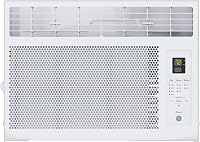
The ClearView is our top pick for most medium rooms. It combines a 10,300 BTU inverter compressor rated for up to 450 sq ft with the lowest noise figure here at 40 dB and a full window view.
The flex-depth design fits walls 4.5 to 13.75 in thick, so it handles deeper sills than a fixed frame. The trade-off is its size and weight at 75.7 lb and a 28 in depth, so plan the install and the lifting help.
Pick it if you want quiet, steady cooling in a living room or large bedroom and the window can take a wider unit. If the window is narrow, move to the LG dual inverter.
Best for smart control and dual inverter cooling: LG 10,000 BTU dual inverter
The LG dual inverter model is the pick when app and voice control matter and the window falls in its 22 to 36 in width range. It cools up to 450 sq ft and runs as low as 44 dB in sleep mode.
Its washable filter slides out for cleaning, and the EZ Mount kit is included. It weighs 62.8 lb, lighter than the ClearView, which helps if you install it yourself.
Choose it over the GE Profile when the window is narrower or you prefer LG's app. It also fits a slightly smaller depth at about 27 in.
Best for smaller rooms and simpler setups: LG 8,000 BTU
The LG 8,000 BTU unit is the pick for rooms up to 350 sq ft when you want simple operation and a lower upfront cost tier. It has three cooling and fan speeds, a remote and a washable filter.
Its auto restart turns the unit back on after a power outage, which helps if you run it overnight. The scroll compressor and higher 53 dB low-mode figure make it a better fit for a living area than a bedside spot.
Pick it when the room is smaller and the window suits a standard install. Move up to the inverter models for quieter nights or rooms near 450 sq ft.
How we scored these window air conditioners
We compared the specs and features against what a buyer looking for the best window air conditioner for cooling actually needs. Our score weighs cooling capacity, inverter type, noise, window fit, controls and energy claims against what you are shopping for.
Scores run from 8.5 to 8.8 here, and the ClearView leads because it combines the widest fit range, the lowest noise figure and app control at the highest BTU of the three. The LG dual inverter lands close behind for its dual inverter design and voice control.
The 8,000 BTU LG rounds out the list as the simple, smaller-room choice.
We did not test these units ourselves. The figures above come from the maker specs and stated features, and we compared them to the needs of each type of room.
Use the comparison as a shortlist, then check the exact window measurements before you order.
What is the best window air conditioner for cooling in a large or sunny room?
For a room up to 450 sq ft with a strong sun load, choose a 10,000 to 10,300 BTU inverter unit. The GE Profile ClearView is the best window air conditioner for cooling in that setting, because it pairs the highest BTU here with quiet inverter operation and a fit that handles deeper sills.
Pick the LG dual inverter if your window falls in its 22 to 36 in width range. Pick the LG 8,000 BTU model when the room is nearer 350 sq ft and simple operation is enough.
In every case, size by square footage first, check the window fit second and choose inverter cooling when the unit will run long hours.
For a unit that also heats in cooler months, see our roundup of the best window air conditioner with heat.
Frequently asked questions
How many BTUs do I need per square foot?
Plan on roughly 20 BTU per square foot as a starting point. A 350 sq ft room calls for about 8,000 BTU and a 450 sq ft room about 10,000 to 10,300 BTU.
Sunny kitchens or rooms with lots of people often need a step up.
Is inverter cooling better than a standard compressor?
Inverter cooling usually runs quieter and holds temperature more evenly, because the compressor varies its speed instead of cycling fully on and off. Standard units often cost less upfront.
For long daily use in a bedroom, the inverter advantages matter more.
How do I know a window AC will fit my window?
Check three numbers against the unit: window width, minimum opening height and the window type. The GE Profile ClearView, for example, fits windows 20 to 40 in wide with a 13 in minimum opening height.
Measure your opening before ordering.
What noise level should I expect from a window AC?
Quieter inverter models reach around 40 to 44 dB, while many standard units run higher. Lower dB figures suit bedrooms and home offices.
Compare the rating for the mode you will actually use, since a quiet sleep setting may differ from full cooling.
Does a higher BTU rating always cool faster?
No. An oversized unit cools the air quickly but shuts off before it removes much humidity, which can leave the room feeling cold and clammy.
A correctly sized unit runs longer and dehumidifies better.
Size by square footage, then add margin for sun and heat load.