How Long Do Window Air Conditioners Last?
Window air conditioners often last about 10 years, though use, upkeep, installation, and climate affect how long they stay useful. Clean the filter and keep airflow clear to reduce avoidable strain.
On this page (7 sections)
- How long do window air conditioners last on average?
- What affects how long a window air conditioner lasts?
- What care helps a window air conditioner last longer?
- What are the signs a window air conditioner may be wearing out?
- Should you repair or replace an aging window AC?
- How do you choose a replacement that will last?
- How long do window air conditioners last, and when should you act?
Window air conditioners often last about 10 years, though use, maintenance, installation, and climate affect how long they stay useful. If you're asking how long do window air conditioners last, treat 10 years as a planning estimate, then judge your unit by cooling, safe operation, and repair history.
There isn't a fixed expiration date. A clean, well-supported unit used for a shorter cooling season may remain useful longer than one that runs hard in a dusty room or sits exposed to harsh weather.
How long do window air conditioners last on average?
About 10 years is a reasonable planning estimate for a window AC. A unit's condition and operating environment matter more than its age alone.
Frequent use adds wear to the fan and cooling system. Dust buildup, blocked airflow, poor drainage, and loose support can also contribute to problems.
An older unit that cools reliably and operates safely may still be worth keeping. One with repeated failures or declining cooling may no longer be a sensible repair.
What affects how long a window air conditioner lasts?
Use, maintenance, climate, and installation all affect a window air conditioner's lifespan. You can reduce avoidable strain with routine care, but maintenance cannot prevent every failure.
A clogged filter restricts airflow. Clean it on the schedule in the owner's manual, and check it more often if the room is dusty or the unit runs frequently.
The unit needs stable support and installation as its manual describes. A poor fit can let air or water pass around the unit, while blocked intake or outlet areas make it harder to move air through the room.
Does leaving a window AC in all year affect its lifespan?
Leaving a window AC installed through winter can expose it to weather and debris, depending on your climate and how the window is protected. Check the manual for off-season care and your building's requirements.
If you remove it, plan how to lift it safely and protect the opening. Our guide on whether to remove a window AC in winter covers the seasonal decision.
What care helps a window air conditioner last longer?
Clean the filter regularly, keep air paths open, and follow the manufacturer's care instructions. Designs differ, so use the owner's manual for cleaning and storage steps.
Keep curtains, furniture, and stored items clear of the intake and outlet. Check seals and side panels for gaps, and look for water where it shouldn't be.
Don't open sealed refrigeration parts or handle electrical components unless you're qualified. Turn the unit off and contact a qualified technician if it trips a breaker, smells hot, or makes a new grinding sound.
Can a washable filter make window AC upkeep easier?
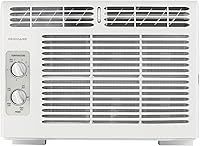
A washable filter makes routine dust removal simpler when you clean and dry it as directed. The Frigidaire 5,000 BTU window air conditioner has a washable filter and is designed for rooms up to 150 sq. ft.
This model suits a compact bedroom or similar space where simple temperature control is enough. Skip it for a larger room or a window that can't accommodate a window-mounted unit.
What are the signs a window air conditioner may be wearing out?
Recurring breakdowns, persistent weak cooling, or new unusual noises can signal trouble. First check for simple causes such as a dirty filter, blocked airflow, or an incorrect thermostat setting.
Water inside, controls that stop responding, or unusual cycling also deserve attention. One symptom doesn't prove the unit has reached the end of its life, so look at the pattern and the unit's age together.
If water appears indoors, see why a window air conditioner leaks water for common causes and checks. If the filter is clean and airflow is clear but cooling remains weak, ask a qualified technician to inspect it.
Is a noisy window AC always near the end of its life?
No, a rattle can come from a loose panel or an installation issue. Turn the unit off before checking accessible mounting points, and follow the manual's instructions.
A steady new hum, grinding sound, or repeated vibration deserves closer attention. Stop using the unit if you notice a burning smell or electrical problem.
For a quieter replacement, compare features in our guide to quiet window air conditioners. The GE 5,000 BTU window air conditioner has 2 cooling modes, 2 fan speeds, and a washable filter for a room up to 150 sq. ft.
This GE suits a small bedroom, dorm room, or home office when its window dimensions fit. Skip it if you need app control, a larger capacity, or a design that preserves the window view.
Should you repair or replace an aging window AC?
Compare repair cost, age, and cooling performance before deciding. A simple maintenance issue may be worth fixing, while repeated faults can make replacement more practical.
Start with safe checks: clean the filter, confirm the thermostat setting, clear obstructions, and make sure the unit is installed as instructed. Leave electrical or refrigerant-system work to a technician.
For a replacement, match capacity to the room and confirm the window can support the model. Our guide to choosing a window air conditioner covers sizing and fit.
When might an inverter window AC suit a replacement?
An inverter model may suit you if you want cooling output that adjusts as needed. The GE Profile ClearView 10,300 BTU inverter window air conditioner is designed for rooms up to 450 sq. ft. and has a full-window-view design.
Measure the window and wall depth before choosing it. This model is for a larger space than the 5,000 BTU options, and its app and remote controls suit buyers who want connected or handheld control.
Skip it if you need a small-room unit or your window can't meet its installation requirements. The design fits windows 20–40 in wide with at least 13 in of opening height, and its adjustable depth accommodates walls 4.5–13.75 in thick.
How do you choose a replacement that will last?
Choose a unit that fits the room and window, then make routine care easy to keep up with. Correct sizing and installation help you avoid unnecessary strain and poor cooling.
First measure the room and window, then compare the manufacturer's coverage with your needs. A 5,000 BTU model is intended for spaces up to 150 sq. ft., while the GE Profile option is designed for up to 450 sq. ft.
Next consider daily use. The Frigidaire offers temperature control and 2 fan speeds, the GE 5,000 BTU model uses mechanical dials, and the GE Profile adds inverter operation, Wi-Fi, and a remote.
Before setup, read the installation instructions, check the window dimensions, and arrange help for lifting a heavy unit. Secure its support and side panels as directed, seal gaps, and keep the intake and outlet unobstructed.
Common mistakes include choosing by BTU alone without measuring the room, forcing a unit into an incompatible window, blocking airflow with curtains, and skipping filter care. Don't use an extension cord unless the manufacturer's instructions allow it.
If you're comparing bedroom options, see window air conditioners for bedrooms. That guide can help narrow the choice by room and use.
How long do window air conditioners last, and when should you act?
Expect about 10 years as a rough guide, then decide based on safe operation, steady cooling, and repair needs. Keep a reliable unit clean and properly installed; replace it when recurring faults or poor cooling outweigh the value of repair.
Choose the Frigidaire or GE 5,000 BTU unit for a small room up to 150 sq. ft. Choose the GE Profile ClearView for a larger room up to 450 sq. ft. when its window fit and added controls match your needs.
If the unit still cools well, runs safely, and has no recurring faults, continued use may make sense. Start with how to choose a window air conditioner when you need to size and fit a replacement.
Frequently asked questions
How long do window air conditioners usually last?
A window air conditioner often lasts about 10 years, but no single lifespan applies to every unit. Usage, cleaning, installation, operating conditions, and repair history all matter.
Watch for recurring problems, weak cooling, or unusual noise as the unit ages.
Can a window air conditioner last 20 years?
Some units may run for 20 years, but that is not a reliable expectation. Long service depends on conditions and maintenance, and older units may need costly repairs.
Compare the repair cost and performance with a suitable replacement before deciding.
How can I make my window air conditioner last longer?
Clean the filter as directed, keep the air intake and outlet clear, and inspect the unit for leaks or damage. Install and support it according to the manual, and protect it during the off-season if appropriate.
These steps reduce avoidable strain but cannot prevent every failure.
When should I replace a window air conditioner?
Consider replacement when the unit has recurring breakdowns, no longer cools the room adequately, or needs a repair that costs too much for its age and condition. First check the filter, thermostat setting, airflow, and installation.
A qualified technician can assess electrical or sealed-system problems.