What Size Portable Air Conditioner Do I Need?
For what size portable air conditioner you need, start with your room’s area and the unit’s stated coverage. Then account for sun, ceiling height, insulation, layout, and heat sources before choosing.
On this page (9 sections)
- What size portable air conditioner do I need for my room?
- How do sun, insulation, and layout affect portable AC size?
- Which portable AC size fits each example room?
- How should I compare BTU and SACC ratings?
- Can a portable AC be too large for a room?
- What should I check before buying and setting up a portable AC?
- How do I care for a portable air conditioner after choosing a size?
- What common sizing mistakes should I avoid?
- Which portable AC size should I choose?
For what size portable air conditioner you need, start with the room’s floor area and the unit’s stated coverage. Then adjust for sun, ceiling height, insulation, room layout, and heat sources, and compare capacity ratings using the same method.
Measure the room before shopping. A shaded bedroom and a sunny open living area can need different cooling even when their floor areas match.
Our portable air conditioner sizing guide explains how capacity ratings fit into the decision. If you already know the room’s area, see the portable ACs for a small room or portable ACs for a large room guides to compare options.
What size portable air conditioner do I need for my room?
Start with the area the unit needs to cool, then account for conditions that add heat or make it harder for air to circulate. Coverage figures are useful starting points, not promises for every room shape or climate.
Measure the room’s length and width in feet, then multiply them. For connected spaces, count the full area you expect the AC to serve, rather than measuring only the area beside the unit.
| Room area | Starting coverage range | Check before choosing |
|---|---|---|
| Up to 150 sq. ft. | A model rated near 150 sq. ft. | Strong sun, high ceilings, or open doorways |
| 150–200 sq. ft. | A model rated around 200 sq. ft. | Whether the room is enclosed or connected |
| 200–300 sq. ft. | A model rated within this range | Insulation, layout, and heat sources |
| 300–400 sq. ft. | A model rated near 400 sq. ft. | Capacity rating and heat load |
| 400–550 sq. ft. | A model rated within this range | Whether one unit can move air across the space |
Use the range to narrow your search, then check the model’s stated room coverage. Actual cooling depends on the AC, installation, room, and outdoor conditions.
How do I measure a room for a portable air conditioner?
Multiply the room’s inside length by its width to get its floor area. A 12 ft by 15 ft room has 180 sq. ft. of floor area.
For an L-shaped room, divide the floor into rectangles, calculate each area, and add them. Include a connected dining or living area if there is no door and you expect the unit to cool it.
Floor area is only a starting point. A high ceiling holds more air than a standard-height ceiling over the same floor, so get sizing advice if your room is unusually tall or has a vaulted ceiling.
How do sun, insulation, and layout affect portable AC size?
Sun, air leaks, and difficult airflow can raise the cooling demand beyond what floor area suggests. Consider them before sizing up, since a larger unit cannot fix poor placement or a room that is hard to close off.
A west-facing room with afternoon sun may need more cooling than a shaded room of the same size. Curtains or blinds can reduce solar heat, but they do not remove it entirely.
Poor insulation and gaps around windows let conditioned air escape and warm air enter. Close doors to rooms the unit does not need to cool, and address obvious window drafts.
An open doorway may let some cool air reach a nearby space, but a portable AC is easiest to size for the room around it. A long, narrow room or one with sharp turns can have uneven airflow.
Cooking equipment, computers, and several people add heat while they are in the room. If those conditions are routine, include them in your decision instead of relying on floor area alone.
Which portable AC size fits each example room?
Match the model’s coverage to your measured space, then check its capacity rating and setup. The four options below suit different room sizes and priorities.
Midea 8,500 BTU: compact rooms up to 150 sq. ft.
The Midea is rated for spaces up to 150 sq. ft., with an 8,500 BTU ASHRAE rating and a 5,000 BTU SACC rating. Compare both numbers when weighing it against other portable units.
Its cooling, fan, and dehumidification modes cover basic room use. App and voice control suit buyers who want to adjust settings remotely, and the included 5 ft hose and window brackets fit openings from 26.5 to 48 in.
Choose it for an enclosed, compact room within its stated coverage. Skip it for a larger, sunny, or open-plan space where the area and heat load exceed that range.
BLACK+DECKER 9,000 BTU: rooms where remote sensing helps
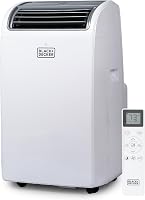
This BLACK+DECKER is rated for spaces up to 400 sq. ft. and has a 5,300 BTU SACC rating. Its Follow Me remote can act as a thermostat, which may help if you sit or sleep away from the unit.
It also has fan and dehumidifier modes, casters, side handles, and an included window kit. The coverage figure is a comparison point, not a guarantee that every room of that size will cool evenly.
Consider it when remote temperature sensing and moving the AC between rooms matter. Skip it if the room’s layout is broad or divided and you need dependable cooling across distant areas.
BLACK+DECKER 12,000 BTU: larger rooms with app control
This 12,000 BTU model is rated for spaces up to 550 sq. ft. and has an 8,350 BTU SACC rating. Its app and voice-control options may suit a larger room where you want to change settings from elsewhere.
It also provides fan and dehumidifier modes, along with a Follow Me remote. Check that the window kit fits your opening, then consider whether the unit’s airflow can reach the far side of your room.
Choose it when your measured area and room conditions fit its stated coverage. Skip it for a small, enclosed room where that capacity may be more than you need, or for a divided layout that limits airflow.
DREO 14,000 BTU: 200–300 sq. ft. rooms with a dual-hose setup
DREO rates this model for 200–300 sq. ft., with 14,000 BTU ASHRAE and 10,000 BTU DOE figures. Its dual-hose design separates intake and exhaust airflow; DREO says this helps reduce hot-air backflow.
The inverter adjusts output, and the unit offers app, remote, and Alexa control. DREO describes its drainage-free operation as suitable for environments under 90% humidity.
Consider it for a mid-size room if the dual-hose window setup works for you. Skip it if you need coverage beyond its stated range or cannot fit the window panels, which support hung and sliding windows from 20 to 53 in.
The higher BTU figure does not automatically make this the best choice for every larger room. Compare the coverage range and rating type alongside the hose setup, as shown in our dual-hose portable AC guide.
How should I compare BTU and SACC ratings?
BTU and SACC describe capacity using different rating approaches, so compare like with like. Use the rating alongside coverage and room conditions instead of shopping by the biggest number.
Portable ACs may show an ASHRAE BTU figure and a SACC figure. Avoid comparing one unit’s ASHRAE number directly with another unit’s SACC number as though they were the same measure.
For example, the Midea is rated at 8,500 BTU ASHRAE and 5,000 BTU SACC. DREO is rated at 14,000 BTU ASHRAE and 10,000 BTU DOE.
Those numbers alone do not tell you which AC fits your room. Compare each model’s stated coverage, the same type of rating, room conditions, and window setup together.
Read how many BTU per square foot an air conditioner needs for a broader look at capacity. It can help frame the comparison, while sun, insulation, and layout guide the final choice.
Can a portable AC be too large for a room?
Yes, far more capacity than a room needs can be a poor fit. The unit may cool the air near its sensor quickly, while other areas still feel warm.
A short cooling cycle may also leave less time to remove moisture than a longer run. That matters if humidity control is one of your reasons for using air conditioning.
Do not size up just because a larger BTU figure looks safer. If you are between options, compare stated coverage and rating types, then account for heat sources and the room’s layout.
What should I check before buying and setting up a portable AC?
Confirm that the window kit fits and the exhaust hose can reach the window before buying. Then place the unit where its airflow can serve the room without blocking the hose or controls.
Measure the window opening and check the supported range and window style. The Midea brackets fit openings from 26.5 to 48 in, while DREO’s panels fit hung and sliding windows from 20 to 53 in.
Plan a short hose route without sharp bends or a stretched connection. Follow the unit’s installation instructions and seal around the window kit so warm outdoor air has fewer gaps to enter.
Choose a spot with room for airflow and access to the controls and filter. If you need help with the process, read how to install a portable air conditioner.
How do I care for a portable air conditioner after choosing a size?
Clean the filter on the schedule for your model, and check its drainage needs before regular use. A dirty filter can restrict airflow, while a full drain area can interrupt operation on models that need draining.
Midea recommends cleaning its removable, reusable filter every week of operation. Follow the instructions for your own unit, since filter access and maintenance schedules vary.
Portable ACs can collect water as they remove moisture from the air. Some models evaporate much of that moisture, but humidity and operating conditions can affect whether draining is needed; learn how to drain a portable air conditioner.
Keep the exhaust hose connected and the window kit in place while cooling. If the room stops cooling well, check airflow and the hose setup before assuming the unit is too small; see why a portable AC may not be cooling.
What common sizing mistakes should I avoid?
The biggest mistakes are sizing by BTU alone, ignoring connected space, and overlooking installation. Correct those before moving up to a larger unit.
- Comparing unlike ratings: Compare ASHRAE with ASHRAE or SACC with SACC, and check the room coverage too.
- Measuring only the main seating area: Include connected areas you expect the AC to cool.
- Ignoring sun and heat sources: Account for sun exposure, computers, cooking, and regular occupancy.
- Assuming an open door cools another room: Walls, distance, and turns can limit airflow.
- Leaving the window setup until later: A hose or panel that does not fit can prevent proper installation.
- Choosing the largest model by default: More capacity is not automatically a better match for a small or divided room.
Which portable AC size should I choose?
Choose the smallest model whose stated coverage includes your measured room and its real heat load. For up to 150 sq. ft., compare the Midea; for 200–300 sq. ft., consider DREO if its dual-hose setup suits your window; for a larger stated range, compare the BLACK+DECKER options.
If the room is unusually tall, open, or strongly sunlit, get sizing guidance before relying on square footage alone. For a final comparison, see the portable ACs for small rooms or portable ACs for large rooms guide, then check coverage, rating type, and window fit against your room.
Frequently asked questions
How do I calculate the room size for a portable air conditioner?
Multiply the room’s length by its width to estimate floor area in square feet. For an open plan, include connected areas the unit must cool, then treat the result as a starting point because sun, ceiling height, insulation, and heat from people or equipment affect the cooling load.
Is a higher BTU portable air conditioner always better?
No. A larger BTU rating can suit a larger or more heat-exposed room, but excess capacity may cool the air quickly without enough run time to manage humidity well.
Match the room and conditions to the maker’s coverage guidance, and compare SACC figures where available.
What does SACC mean on a portable air conditioner?
SACC is a portable air conditioner cooling-capacity rating that accounts for the way the unit operates in a room, including heat effects from its exhaust setup. Compare SACC figures alongside room coverage rather than treating an ASHRAE BTU number as the only sizing measure.
Should I size up a portable AC for a sunny room?
A sunny room can need more cooling than a shaded room of the same area, especially with large windows or several warm appliances. Use the maker’s coverage range as a baseline, then consider those extra heat sources before choosing a larger model.
Can one portable air conditioner cool two rooms?
A portable AC is usually easiest to size for the room where it sits. Open doorways may let some cool air move into a nearby space, but walls, turns, and distance limit that airflow, so don’t count on one unit to cool two separate rooms evenly.