8 Best Dual Hose Portable Air Conditioners (October 2026)
The best dual hose portable air conditioners include the Dreo 14 for connected bedrooms, the Midea Duo 14 for larger smart rooms, and the Midea Duo 14 for supplemental heat.
On this page (10 sections)
- How did we choose the best dual hose portable air conditioners?
- Which dual hose portable ACs are easiest to compare?
- Which dual hose portable air conditioner suits each buyer?
- What should you check before choosing a dual hose portable AC?
- How do dual hose portable air conditioners work?
- How do you set up a dual hose portable air conditioner?
- What care and use habits help a portable AC work well?
- What mistakes should you avoid when buying a dual hose AC?
- Are dual hose portable air conditioners right for your room?
- Which dual hose portable air conditioner should you choose?
The best dual hose portable air conditioner for most buyers is the Dreo 14,000 BTU inverter model, which combines separate intake and exhaust paths with app, remote and Alexa controls. Choose Midea Duo with heat for a heat pump, or Whynter if you want dehumidifying and fan modes.
Dual hose units need an outdoor air path, a suitable window and enough floor space for the cabinet and hoses. Start with our portable air conditioner guide for more models, or compare fixed-window options in our window AC guide.
Our picks at a glance
-
1
 Best for connected bedrooms
Dreo 14,000 BTU dual hose inverter portable air conditioner
8.8/10 our score
See it on Amazon -
2
 Best for larger smart rooms
Midea Duo 14,000 BTU inverter portable air conditioner
8.7/10 our score
See it on Amazon -
3
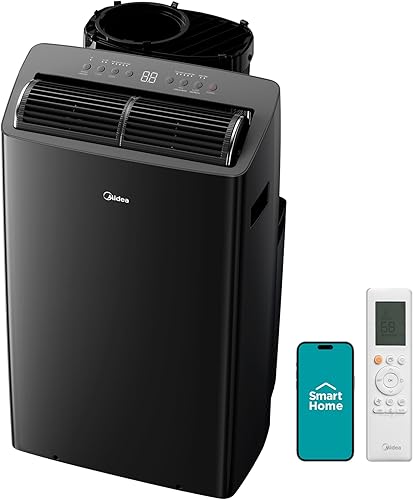 Best for supplemental heat
Midea Duo 14,000 BTU inverter portable air conditioner with heat
8.6/10 our score
See it on Amazon
- 4
 Check it
Midea 13,000 BTU dual hose inverter portable air conditioner
Best for midsize connected spaces - 5
 Check it
Hisense 8,000 BTU twin hose inverter portable air conditioner with heat
Best for smaller heated rooms - 6
 Check it
Whynter ARC-147WF 14,000 BTU dual hose portable air conditioner
Best for dehumidifying rooms - 7
 Check it
Hisense 8,000 BTU dual hose inverter portable air conditioner
Best for app-managed cooling - 8
 Check it
SereneLife 12,000 BTU inverter portable air conditioner with heat
Best for four operating modes
How did we choose the best dual hose portable air conditioners?
We compared cooling ratings, hose layouts, inverter operation, stated room coverage, controls and extra modes against common buying needs. The score reflects how each model’s features match shoppers looking for dual hose cooling and practical room fit.
The highest BTU figure does not automatically make the best choice. Room shape, sunlight, ceiling height, insulation, window fit and where the air can circulate all affect comfort.
Which dual hose portable ACs are easiest to compare?
These picks range from 8,000 to 14,000 BTU cooling ratings and include models with heat, app controls, dehumidifying and fan modes. Use the comparison to narrow your choice, then confirm the window setup and room coverage for your own space.
| Product | Best for | Cooling | Hose design | Controls | Our score |
|---|---|---|---|---|---|
| Dreo 14,000 BTU dual hose inverter portable air conditioner | connected bedrooms | 14,000 BTU ASHRAE (10,000 BTU DOE) | Dual hose | App, remote and Alexa | 8.8 |
| Midea Duo 14,000 BTU inverter portable air conditioner | larger smart rooms | 14,000 BTU (12,000 BTU SACC) | App, voice and remote | 8.7 | |
| Midea Duo 14,000 BTU inverter portable air conditioner with heat | supplemental heat | 14,000 BTU (12,000 BTU SACC) | 8.6 | ||
| Midea 13,000 BTU dual hose inverter portable air conditioner | midsize connected spaces | 13,000 BTU (10,000 BTU SACC) | App, remote, Alexa and Google Assistant | 7.9 | |
| Hisense 8,000 BTU twin hose inverter portable air conditioner with heat | smaller heated rooms | 8,000 BTU DOE | 7.7 | ||
| Whynter ARC-147WF 14,000 BTU dual hose portable air conditioner | dehumidifying rooms | 14,000 BTU (10,000 BTU SACC) | 7.6 | ||
| Hisense 8,000 BTU dual hose inverter portable air conditioner | app-managed cooling | 8,000 BTU DOE/SACC (10,000 BTU ASHRAE) | ConnectLife app, Google and Alexa | 7.4 | |
| SereneLife 12,000 BTU inverter portable air conditioner with heat | four operating modes | 12,000 BTU ASHRAE | Dual hose | 7.3 |
Which dual hose portable air conditioner suits each buyer?
The Dreo is the leading all-round choice for connected controls and inverter operation. Other options suit larger stated room coverage, supplemental heat, or buyers who want more operating modes.
Dreo 14,000 BTU dual hose inverter portable air conditioner: Best for connected bedrooms
- 14,000 BTU ASHRAE cooling
- Dual hose
- Inverter
- App, remote and Alexa control
- 42 dB noise level
The Dreo pairs dual hoses and inverter control with app, remote and Alexa options. Its 42 dB noise level and self-evaporating design suit buyers who want several convenience features in one unit.
Pros
- App, remote and Alexa control
- Dual hose and inverter design
- Self-evaporating design for environments under 90% humidity
Cons
- Dreo's room range is 200–300 sq ft
- Window fit range is 20–53 in
The Dreo is the top pick for connected bedrooms and living spaces. It supports app, remote and Alexa control, and its stated noise level is 42 dB.
Its cooling rating is 14,000 BTU ASHRAE, or 10,000 BTU DOE. Dreo gives a room range of 200–300 sq ft, so this model is best for modest rooms rather than large, open spaces.
The inverter adjusts its output, and the dual hose arrangement separates intake and exhaust airflow. Dreo describes its self-evaporating system as drainage-free in environments under 90% humidity, though a drain hose is included for situations that call for drainage.
It fits hung and sliding windows 20–53 in wide. Choose it if the window range matches and you value app or voice control; skip it if you need a unit for a much larger room or your window opening falls outside that range.
Midea Duo 14,000 BTU inverter portable air conditioner: Best for larger smart rooms
- 14,000 BTU cooling
- Duo hose-in-hose design
- Inverter
- App, voice and remote control
- 42 dB minimum noise
Midea Duo pairs its hose-in-hose design with inverter operation, app connectivity and voice control. It covers up to 550 sq ft and runs as low as 42 dB.
Pros
- App and voice control
- Hose-in-hose intake and exhaust
- Coverage up to 550 sq ft
Cons
- 75 lb unit
- No heat mode
Midea Duo suits buyers who want smart controls and stated coverage up to 550 sq ft. Its hose-in-hose design sends intake and exhaust air outdoors, while variable-speed inverter operation adjusts output.
The cooling rating is 14,000 BTU, with 12,000 BTU SACC. It runs as low as 42 dB and supports app and voice control through Alexa and Google Assistant.
At 75 lb and 32.48 in tall, it needs a planned location near a suitable window. Plan for its size when selecting a spot.
Choose it for a larger room when its coverage guidance fits, and when app or voice operation is useful. Skip it if you need heat or expect to move the unit frequently.
This model does not include heat. For a heat pump version, compare it with the Midea Duo with heat and check that model’s operating range.
Midea Duo 14,000 BTU inverter portable air conditioner with heat: Best for supplemental heat
- 14,000 BTU cooling
- Heat pump
- Duo hose-in-hose design
- App and voice control
- 42 dB cooling noise
This Midea Duo adds heat pump operation to its hose-in-hose and inverter design. Its heat pump operating range is 41°F–86°F.
Pros
- Cooling and heat in one unit
- App and voice control
- Coverage up to 550 sq ft
Cons
- 77.2 lb unit
- Heat pump operating range is 41°F–86°F
The Midea Duo with heat is the pick for buyers who want cooling and a heat pump in one portable unit. It shares the hose-in-hose design, inverter operation and smart controls of the cooling-only Duo.
It has a 14,000 BTU cooling rating, with 12,000 BTU SACC, and covers up to 550 sq ft. The heat pump’s operating range is 41°F–86°F, so check that against the conditions where you expect to use it.
App and voice control add flexibility, while the cooling noise is as low as 42 dB. The unit weighs 77.2 lb, so consider where it will stay after installation.
Choose this model when you need both functions and can work within the heat pump range. Skip it if you only need cooling or expect to carry it between rooms often.
For other heat-capable portable options, see our portable ACs with heat guide.
Midea 13,000 BTU dual hose inverter portable air conditioner: Best for midsize connected spaces
- 13,000 BTU cooling
- Dual hose
- Inverter
- Wi-Fi app, Alexa and Google Assistant control
Midea's 13,000 BTU model combines dual hoses and inverter operation with app and voice controls. It covers up to 450 sq ft.
Pros
- App, remote and voice control
- Dual hose and inverter design
- Coverage up to 450 sq ft
Cons
- No heat mode
- Room coverage is an estimate
Midea’s 13,000 BTU model fits midsize spaces where voice control matters. It combines dual hoses and inverter operation with SmartHome app control, smartwatch control, Alexa and Google Assistant.
It covers up to 450 sq ft, with a 10,000 BTU SACC rating. The adjustable window kit and mounting hardware support setup in vertical or horizontal windows, and the unit weighs 55.3 lb.
Its stated coverage is lower than the two 14,000 BTU Midea Duo models above. Choose it if your room fits the stated range and you want connected controls; skip it if you need heating or have a room larger than its coverage guidance.
Hisense 8,000 BTU twin hose inverter portable air conditioner with heat: Best for smaller heated rooms
- 8,000 BTU DOE cooling
- Twin hose
- Inverter
- Heating and cooling
- Self-evaporating design
Hisense combines twin hoses and inverter operation with cooling and supplemental heat. Its self-evaporating design is paired with a drain connection for continuous drainage in heating and dehumidifying modes.
Pros
- Cooling and heating modes
- Twin hose and inverter design
- Self-evaporating operation plus continuous drain option
Cons
- Lower cooling rating than the larger picks
- Tall tower form at 49.4 in
The Hisense twin hose with heat fits smaller rooms that need supplemental heating. Its 8,000 BTU DOE cooling capacity is paired with inverter technology, a twin hose system and a snap-in window kit.
It covers up to 350 sq ft. The fan sends cool air up to 21 ft with 60-degree coverage, and the tower form is 49.4 in high, so check the space above and around it.
The self-evaporating system handles condensation, while a raised drain-hose connector supports continuous drainage for heating and dehumidifying modes. Wi-Fi connectivity works through the ConnectLife app.
Choose it if heating is useful and your space is within its stated coverage. Skip it if your room needs the stronger cooling ratings of the larger-capacity picks.
Whynter ARC-147WF 14,000 BTU dual hose portable air conditioner: Best for dehumidifying rooms
- 14,000 BTU cooling
- Dual hose
- Dehumidifier and fan modes
- Remote control
- Auto drain function
The Whynter adds dehumidifying and fan modes alongside cooling, with a remote and auto drain function. Its dual hose design suits shoppers who do not need inverter or smart controls.
Pros
- Cooling, dehumidifying and fan modes
- Auto drain function
- Includes a storage cover bag
Cons
- No inverter
- No Wi-Fi or app control
The Whynter ARC-147WF is the choice for cooling with dehumidifying and fan modes. It has a 14,000 BTU rating, with 10,000 BTU SACC, and covers up to 500 sq ft.
Its dual hose system works without inverter operation, app connectivity or voice control. A remote handles settings, and the auto drain function exhausts condensate in most environments.
The package includes window installation accessories and a storage cover bag. Temperature control ranges from 61°F to 89°F.
Choose it if the extra modes matter and you are comfortable with remote-only control. Skip it if you want inverter operation, connected controls or heat.
Hisense 8,000 BTU dual hose inverter portable air conditioner: Best for app-managed cooling
- 8,000 BTU DOE/SACC cooling
- Dual hose
- Inverter
- Wi-Fi app control
- 42 dB in quiet mode
This Hisense pairs an 8,000 BTU DOE/SACC cooling rating with dual hoses, inverter operation and Wi-Fi app control. Its quiet mode runs at 42 dB.
Pros
- Dual hose and inverter design
- Wi-Fi with Google and Alexa compatibility
- 42 dB quiet mode
Cons
- No heat mode
- Floor area is not specified
This Hisense is the pick for app-managed dual hose cooling. It has 8,000 BTU DOE/SACC cooling, or 10,000 BTU ASHRAE, and supports ConnectLife app compatibility with Google and Alexa.
Its quiet mode runs at 42 dB. Floor area is not specified, so confirm that the cooling capacity suits your room instead of relying on a square-foot estimate.
The unit measures 12.9 in deep, 17.5 in wide and 28.3 in high. Choose it if a compact cabinet and connected control fit your priorities; skip it if you need heat or a stated coverage figure.
SereneLife 12,000 BTU inverter portable air conditioner with heat: Best for four operating modes
- 12,000 BTU cooling
- Dual hose
- Inverter
- Cooling, heat, fan and dehumidifier modes
- Wi-Fi app control
SereneLife combines dual hoses and inverter operation with four modes and Wi-Fi app control. It includes a window kit and two exhaust hoses.
Pros
- Four operating modes
- App, remote and touch controls
- Includes window installation parts
Cons
- Noise is stated at 44–49 dBA in the features
- Room coverage is not specified
SereneLife suits buyers who want four modes in one dual hose inverter unit: cooling, heat, fan and dehumidifier. It has a 12,000 BTU ASHRAE cooling rating, Wi-Fi app control, a touch panel and remote.
Its stated noise range is 44–49 dBA. Room coverage is not specified, so compare the cooling rating with your room conditions before choosing it for a large space.
The package includes two exhaust hoses, a window installation plate, foam seals and a remote. At 49 lb, it is the lightest unit in this group.
Choose it if all four modes and app control fit your routine. Skip it if you need a clearly stated room-size range before choosing.
What should you check before choosing a dual hose portable AC?
Match the cooling rating to your room and window before comparing extra features. Dual hose airflow can help avoid the pressure imbalance associated with many single hose units, but it cannot make an undersized AC a good fit for a large, sunny room.
How much cooling capacity does a dual hose portable AC need?
Start with floor area, then account for sun exposure, insulation, ceiling height, people and equipment that add heat. Compare the unit’s stated room guidance with your space and use our portable AC sizing guide before choosing a rating.
BTU labels use different measures. Dreo gives ASHRAE and DOE ratings, while Midea models include BTU and SACC figures, so compare the same rating method when possible.
A room’s layout matters too. A long room, a doorway to an open area, or strong afternoon sun can make a unit work harder than the floor area alone suggests.
Will the window kit and hoses fit?
Check whether your window slides vertically or horizontally, then measure the usable opening. Dreo specifies hung and sliding window fit from 20–53 in; other kits have their own requirements.
Plan for the window panel, both air paths and the AC cabinet as one setup. The hoses need to reach outdoors without a pinched bend, while the unit needs enough space to draw and circulate air.
A window that opens only a little, has unusual trim, or sits behind furniture may complicate installation. Confirm the panel range and hose route before buying, especially in a rental where you cannot change the window.
Do you need heat, app control or drainage options?
Choose a heat-capable model if supplemental warmth matters, and check its operating range. Midea Duo with heat operates from 41°F to 86°F, while the Hisense twin hose model supports continuous drainage in heating and dehumidifying modes.
Connected controls are available on Dreo, Midea, Hisense and SereneLife models in this group. Whynter instead offers remote control, dehumidifying and fan modes, which may be enough if smart-home features are not a priority.
Drainage needs depend on mode, humidity and design. Dreo’s self-evaporating system is described for environments under 90% humidity, and the Hisense tower has a continuous drain connection for certain modes.
How do dual hose portable air conditioners work?
A dual hose portable AC uses one air path to bring outdoor air in and another to send warm air outside. That can help avoid the vacuum effect associated with standard single hose designs, though room size, sealing and installation still affect cooling.
Both hoses connect the unit to a window panel, so setup is part of choosing the right model. Read our portable AC installation guide before purchase if you want a clearer view of the window, panel and hose steps.
During operation, keep the intake and exhaust paths open. Blocking a hose with curtains, furniture or a sharp bend can undermine airflow and make the room less comfortable.
How do you set up a dual hose portable air conditioner?
Place the unit close enough to the window for the hoses to reach without stretching or crushing them. Assemble the window panel for your window direction, connect the hoses as instructed for that model, and seal gaps around the panel.
Before switching the unit on, check that the cabinet stands level and that air can move around its vents. Keep the hoses away from hot appliances and avoid routing them where people can trip or where a door will press against them.
The window and room should also be ready for cooling. Close the window around the panel, shut doors to rooms you are not cooling, and draw blinds or curtains against direct sun when practical.
What care and use habits help a portable AC work well?
Keep the filter and air path clear, and follow the care steps for your model. A clogged filter or blocked vent can limit airflow, while a hose connection that loosens or leaks can send heat back into the room.
Check the unit’s drainage guidance before using dehumidifying or heating modes. Some models evaporate much of their condensation in typical conditions, but high humidity or a mode with a drain requirement may call for a hose or manual drainage.
At the end of a cooling period, use the model’s recommended shutdown and storage steps. For detailed upkeep, see how to clean a portable air conditioner and how to drain a portable air conditioner.
What mistakes should you avoid when buying a dual hose AC?
The most common buying mistake is choosing by BTU number alone. Room coverage, rating method, window compatibility, hose reach and heating needs all matter, and a high-capacity unit can still be awkward if it does not fit the space.
Avoid assuming every “dual hose” layout is identical. Some models use two separate hoses, while Midea Duo uses a hose-in-hose design; compare how the window kit and cabinet will fit your own room.
Do not overlook weight and dimensions. The Midea Duo cooling model weighs 75 lb, while the heat version weighs 77.2 lb.
The Hisense heat model is a 49.4 in tower, so decide whether the unit will stay in one place or move between rooms before buying.
Finally, do not treat a room coverage number as a promise for every home. Sun, insulation and an open floor plan can change the cooling demand, so leave room for those conditions in your decision.
Are dual hose portable air conditioners right for your room?
A dual hose unit makes sense when you need a portable installation and want separate intake and exhaust paths. It may not suit a window that cannot accept a kit, a layout where hoses block a walkway, or a room larger than the model’s stated coverage.
If you are open to other hose designs, compare this list with our best rated portable air conditioners. For a room-by-room choice between portable and window formats, see portable air conditioner or window unit.
A window unit may be a better fit when you can install one and prefer to keep the floor clear. A portable model can be easier to relocate or remove, but it still needs a window connection and takes up indoor space.
Which dual hose portable air conditioner should you choose?
Choose the Dreo for connected controls in a 200–300 sq ft room, the Midea Duo for larger stated coverage, or the Midea Duo with heat if you also want a heat pump within its operating range. Pick Whynter for dehumidifying and fan modes, and compare the smaller Hisense models when lower cooling capacity or heat is the priority.
Before you decide, measure the window, map the hose route and check where the cabinet will sit. Those steps help you choose the best dual hose portable air conditioner for your room instead of paying for capacity or features you cannot use.
Our top 3 picks at a glance
-
1
Best for connected bedrooms
Dreo 14,000 BTU dual hose inverter portable air conditioner
8.8/10 our score
See it on Amazon -
2
Best for larger smart rooms
Midea Duo 14,000 BTU inverter portable air conditioner
8.7/10 our score
See it on Amazon -
3
Best for supplemental heat
Midea Duo 14,000 BTU inverter portable air conditioner with heat
8.6/10 our score
See it on Amazon
Frequently asked questions
Are dual hose portable air conditioners better than single hose models?
A dual hose design uses one path to bring in outdoor air and another to send warm air out, which can help avoid the vacuum effect associated with standard single hose units. Cooling results depend on room size, window sealing, heat load and model, so match the unit to your space and installation.
What size dual hose portable air conditioner do I need?
Start with the room area and the unit's cooling rating, then account for sun, ceiling height and other heat sources. Manufacturer coverage is a starting point, not a guarantee.
Our portable AC sizing guide explains the room checks.
Do dual hose portable ACs need a window?
Yes, these units need a way to route intake and exhaust air outdoors, usually through a window kit. Check your window type and opening dimensions before choosing a model.
Dreo fits hung and sliding windows 20–53 in wide; other kits may differ.
Can a dual hose portable air conditioner heat a room?
Some models include heat, such as the Midea Duo with heat, Hisense 8,000 BTU twin hose and SereneLife 12,000 BTU model here. Check the unit's heating range and intended role, since supplemental heat may not meet every heating need.
How should I compare dual hose portable AC noise?
Compare noise figures when the operating mode and measurement are clear. Dreo runs at 42 dB, Midea Duo as low as 42 dB, and the Hisense dual hose model gives 42 dB in quiet mode.
Room acoustics and distance also affect what you hear.


