Midea Portable Air Conditioner vs Hisense: Which Is Better? (October 2026)
Choose Midea Duo for a larger room and Hisense for a smaller space with a twin-hose setup. Midea covers spaces up to 550 sq ft, while Hisense is rated for 350 sq ft.
On this page (6 sections)
Choose Midea Duo for a larger room and Hisense for a smaller space with a twin-hose setup. Midea covers spaces up to 550 sq ft, while Hisense is rated for 350 sq ft.
Both brands offer inverter portable air conditioners with heat and two-hose designs. The main differences are room coverage, hose layout, controls and condensation management.
This comparison covers two heat-and-cool models first. A cooling-only Midea Duo is also included for shoppers who don't need heat.
 Best for cooling without heat
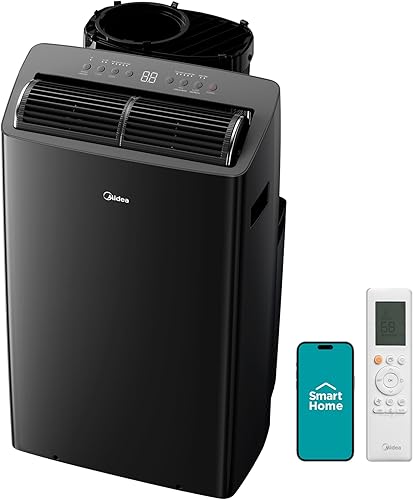
Midea Duo 14,000 BTU inverter portable air conditioner
 Best for larger rooms
Midea Duo 14,000 BTU inverter portable air conditioner with heat
Midea portable air conditioner vs Hisense: which fits your room?
Midea Duo suits a larger room by its stated coverage, while Hisense is rated for up to 350 sq ft. Check your room dimensions and conditions before choosing by BTU alone.
The Midea Duo with heat has 14,000 BTU of cooling power and is made for spaces up to 550 sq ft. Hisense has 8,000 BTU and a 350 sq ft room rating.
Those ratings make Midea a starting point for a larger living area. Hisense may fit better in a smaller room where its lower capacity is closer to the need.
Room shape, direct sun and heat from appliances can affect comfort. Our portable AC sizing guide can help you choose a suitable capacity.
Midea vs Hisense portable AC for a smaller room
For a room around Hisense's 350 sq ft rating, Hisense may be the closer fit on paper. Midea's higher capacity and larger body may be more than the space calls for.
Hisense is a tower measuring 49.4 in high. Midea with heat is 34.48 in high, with a width of 19.53 in and a depth of 16.73 in.
Measure the available floor area, window opening and route to the room. A unit that fits the cooling need still needs a practical place to stand and a window that works with its kit.
How do the Midea and Hisense hose designs differ?
Midea uses a hose-in-hose design, while Hisense uses a twin-hose system. Both connect through a window, but their installation parts and layout differ.
Midea's dual hose-in-hose design intakes and exhausts air outdoors. Midea says the design creates balanced indoor air circulation and helps prevent hot outdoor air from entering through gaps.
Hisense has a built-in twin-hose system and a snap-in window kit. Its design is intended for quick setup, though your window type and available clearance still matter.
For broader tradeoffs between portable and window-mounted cooling, see our guide to portable air conditioners versus window units. If you are comparing two-hose models, our best dual-hose portable air conditioners guide covers that group.
Which unit makes more sense for heating?
Both heat-and-cool models include a heat pump function, but Midea gives an operating range of 41°F to 86°F. Hisense provides supplemental heating, with no operating range specified.
Midea Duo with heat pairs its 14,000 BTU cooling rating with heat pump operation. Hisense combines 8,000 BTU cooling with supplemental heat.
Check the exact model's manual for operating limits and setup requirements. To compare other cooling and heating options, see our guide to portable air conditioners with heat.
When should you choose the cooling-only Midea?
Pick the cooling-only Midea Duo if you want the 550 sq ft coverage rating and don't need heat. It shares the dual hose-in-hose design and app and voice control options with the heat model.
The cooling-only version is 32.48 in high, compared with 34.48 in for the heat model. Both have the same stated width and depth.
If you need winter heating, choose the heat model or Hisense instead. Check the model name to confirm which functions it includes.
How do controls and daily care compare?
Both brands offer smart controls, while Hisense gives more detail about drainage. Consider whether you want app access, voice commands or a way to manage water during heating and dehumidifying.
Midea Duo with heat supports control through the SmartHome app, Alexa and Google Assistant voice control, push buttons and a remote. Hisense has app, remote and touch controls, with Wi-Fi connectivity and Matter-compatible smart-home integration.
Hisense uses self-evaporative operation and has a garden-hose connection for continuous drainage in heating and dehumidifying modes. This can reduce manual emptying in those modes when a suitable drain is available.
Hisense has a washable, removable filter. Check each model's manual for filter care instructions.
Which is quieter, Midea or Hisense?
Hisense has a 39 dB noise figure, and Midea's is 42 dB during cooling. These figures don't guarantee how loud either unit will seem in your room.
The Hisense description gives a 39 dB noise figure. Midea gives 42 dB for its Duo models during cooling.
Noise can vary with the room, placement and operating mode. If you plan to use the unit while sleeping, consider airflow direction and how close the AC will sit to the bed as well as the stated figure.
Which Midea or Hisense portable AC should you choose?
Choose Midea Duo with heat for a larger room, or Hisense for a smaller space with a twin-hose setup and drainage options. Pick the cooling-only Midea if you want its larger room rating without heat.
Choose based on room coverage first, then the features you'll use. Compare the two heat models in our Midea Duo review and consider your window setup before deciding.
Frequently asked questions
Is Midea or Hisense better for a large room?
Midea Duo is the closer fit by room coverage: it is rated for spaces up to 550 sq ft, while Hisense is rated for 350 sq ft. Room layout, sun exposure and other heat sources can affect comfort, so use those figures as a starting point and consider your actual space.
Do both portable air conditioners have heat?
The Midea Duo B0FC2SGGF9 and Hisense B0DNRMZMTF include heat pump functions. The separate Midea Duo B0GV45RBM2 is a cooling-only model, so check the exact model name if heating is part of your plan.
Which has the easier drainage setup?
Hisense is self-evaporative and has a raised drain-hose connector for continuous drainage in heating and dehumidifying modes. Its product information doesn't describe an equivalent drainage feature for Midea.
Are Midea and Hisense both dual-hose portable ACs?
Both use two-hose designs, but the layouts differ. Midea uses a dual hose-in-hose design that takes in and exhausts air outdoors, while Hisense uses a twin-hose system with a snap-in window kit.


