Midea Duo Review: 14,000 BTU Inverter Portable AC (October 2026)
The Midea Duo review points to a strong fit for rooms where you want dual-hose cooling, inverter operation and app or voice controls. Choose the cooling-only model if you do not need heat, or the separate heat model if its operating range suits your winters.

On this page (10 sections)
- What does the Midea Duo review recommend?
- How does the dual-hose design affect cooling?
- Is the Midea Duo quiet enough for a bedroom?
- What room size fits the Midea Duo?
- How should you plan setup and placement?
- When is the Midea Duo with heat the better choice?
- How does Midea Duo compare with other dual-hose ACs?
- What should you check before buying?
- How do you care for and use a portable AC?
- Is the Midea Duo review a good fit for your room?
The Midea Duo review points to a good fit if you want a portable AC with a dual-hose design, inverter operation and app or voice controls. The cooling-only model is the straightforward choice for summer use; its separate heat version suits a room that also needs heat within the heat pump's operating range.
Both models are substantial floor units that need a window exhaust setup. Measure the room, window and path to the final spot before choosing.
What does the Midea Duo review recommend?
The Midea Duo is a strong match for a room where you want connected controls and a dual-hose portable AC that can stay near a suitable window. Its cooling-only version is the better fit if you do not need heat.
Midea Duo 14,000 BTU inverter portable air conditioner: Best for connected cooling

- 14,000 BTU cooling
- Dual hose-in-hose design
- Inverter technology
- App and voice control
A dual-hose inverter portable AC with app and voice controls. Its 75 lb weight and tall cabinet call for a planned spot near a suitable window.
Pros
- Dual hose-in-hose intake and exhaust design
- App, remote and voice controls
- Midea states cooling noise as low as 42 dB
- Inverter technology
Cons
- At 75 lb, moving it between rooms takes planning
- Needs a window installation for the exhaust hose
- No heating function is specified for this model
The cabinet weighs 75 lb and stands 32.48 in tall. Leave space for the window panel and hose, an accessible outlet, and a clear path for air to move from the unit into the room.
Midea gives the cooling-only model a capacity of 14,000 BTU, or 12,000 BTU SACC, and describes it for spaces up to 550 sq ft. Treat the room figure as a starting point: sunlight, ceiling height, insulation and open doorways can affect what size works well.
The unit also offers app, remote and voice control. Those features are useful if you want to adjust settings from across the room or use a compatible Alexa or Google Assistant device.
Who should choose the Midea Duo?
Choose the cooling-only Midea Duo if you want app or voice access, a dual-hose design and cooling for a room that suits its size guidance. Skip it if you want a light unit you can carry often, a window-free setup, or a unit with heat.
The cabinet is meant for a planned location, not constant trips up and down stairs. If you need to cool different rooms, check whether the weight and window kit make that routine practical.
How does the dual-hose design affect cooling?
The Midea Duo takes in and exhausts air outdoors through a dual hose-in-hose design. Midea says this supports balanced indoor air circulation and helps keep hot outside air from seeping in through gaps.
A portable AC still needs a path to send heat out of the room. Install the window panel and hose as directed, then check the panel edges and hose connection for gaps that could let hot air back inside.
Keep the air outlet clear of curtains and furniture. Midea describes airflow reaching up to 26 ft and a 102-degree cooling swing, so position the unit where its airflow can reach the occupied part of the room.
If you are weighing a portable unit against a window model, our portable AC versus window unit guide explains the space and installation trade-offs. A portable unit occupies floor space and uses a window hose; a window AC sits in the opening instead.
Is the Midea Duo quiet enough for a bedroom?
Midea states that the Duo can operate at as low as 42 dB while cooling. That figure gives you a useful point of comparison, but the sound you hear can vary with the fan setting, room and installation.
Inverter technology adjusts compressor output instead of relying only on repeated full-power cycles. Midea says the Duo uses less electricity than traditional portable units and claims savings of more than 40% compared with the U.S. federal standard.
That percentage is a brand claim, not a forecast of your energy bill. Your cooling schedule, temperature setting, room heat and local electricity rate all affect energy use.
For a bedroom, place the unit so the airflow does not blow directly toward the bed. Try the controls and fan settings during the day, then settle on a setting that fits your sleep and cooling needs.
What room size fits the Midea Duo?
Midea specifies the cooling-only model for spaces up to 550 sq ft. Its capacity is stated as 14,000 BTU and 12,000 BTU SACC, so compare the SACC figures with other portable ACs when available.
Room area is only one part of sizing. A sunny room, high ceiling, weak insulation or open connection to another space can raise the cooling load.
Measure the room and note where heat enters during the day before you decide. Our portable AC sizing guide covers these factors and helps you compare capacity to your space.
Do not assume a large capacity figure will cool every connected room evenly. A long or obstructed route from the AC to the far end of an open area can leave temperatures uneven.
How should you plan setup and placement?
Plan to install the Midea Duo beside a suitable window with enough floor space for its cabinet and hose. Measure the window opening, the vertical clearance, and the route between the window and the unit before bringing it into the room.
The 75 lb cooling-only unit is easier to place if you decide its final spot first. Check that the hose can connect without a sharp bend and that the outlet remains easy to reach.
Midea describes a vertical pull-out installation designed to take less storage space. Keep the installation parts together if you expect to remove the panel for storage, and follow the instructions for your window type.
Our portable AC installation guide covers general setup checks. Use the Midea manual for the exact steps and clearances for your model.
A few common setup mistakes can reduce comfort. Avoid blocking the intake or outlet, leaving gaps around the panel, or routing the hose where it can be crushed or sharply bent.
When is the Midea Duo with heat the better choice?
Choose the Midea Duo with heat when you want one portable unit for cooling and heat and its stated heat pump range fits your use. The heat pump is rated to operate from 41°F to 86°F.
Midea Duo 14,000 BTU inverter portable air conditioner with heat: Best for year-round rooms
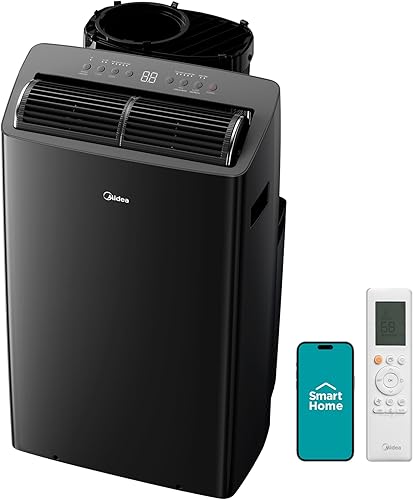
- 14,000 BTU cooling
- Dual hose-in-hose design
- Inverter technology
- Heating function
This version adds a heat pump to the Midea Duo format. Its cabinet is 2 in taller than the cooling-only model, so recheck the window panel and storage space.
Pros
- Heating and cooling in one unit
- Dual hose-in-hose design
- App and voice control options
- Inverter technology
Cons
- At 77.2 lb, it is a heavy unit to reposition
- Heat pump operating range is 41°F to 86°F
- Remote needs 2 AAA batteries
This model is 2 in taller and weighs 77.2 lb. Check the window clearance and storage space again, since the cooling-only model's measurements do not apply to this version.
The heat model also has app and voice control options. Its remote needs 2 AAA alkaline batteries, so have those ready if remote operation is part of your plan.
Skip the heat version if you only need summer cooling or if you need heat outside its stated operating range. In that case, the cooling-only model avoids paying for a feature you will not use.
How does Midea Duo compare with other dual-hose ACs?
The Midea Duo stands out for inverter operation and connected controls, while the alternatives differ in room guidance, drainage features and control options. Compare like-for-like capacity labels, especially when one figure is ASHRAE and another is SACC or DOE.
| Model | Cooling | Stated room size | Notable difference |
|---|---|---|---|
| Dreo dual-hose inverter | 14,000 BTU ASHRAE (10,000 BTU DOE) | 200–300 sq ft | Dreo says drainage-free below 90% humidity |
| Midea Duo | 14,000 BTU (12,000 BTU SACC) | Up to 550 sq ft | Inverter, app and voice control |
| Midea Duo with heat | 14,000 BTU (12,000 BTU SACC) | Not specified | Adds heat pump |
| Whynter ARC-147WF | 14,000 BTU (10,000 BTU SACC) | Up to 500 sq ft | Remote, dehumidifier and carbon filter |
For another brand comparison, see our Midea portable AC versus Hisense guide. If you are building a shortlist around this design, our best dual-hose portable air conditioners guide covers more options.
Dreo is worth considering if its stated 200–300 sq ft range better matches your room. It includes app, remote and Alexa control, and Dreo says its self-evaporating system avoids manual drainage in environments under 90% humidity.
The Whynter ARC-147WF may suit you if a remote, built-in dehumidifier and carbon filter matter more than app or voice control. Its stated cooling capacity is 10,000 BTU SACC, a useful comparison point against the Midea's 12,000 BTU SACC.
What should you check before buying?
Check room fit, window fit, weight and the features you will use before deciding. These factors are more useful than choosing from a single BTU figure.
- Room: Compare your room and heat conditions with the model's stated capacity and room guidance.
- Window: Confirm the opening works with the installation method and that the hose can reach without a sharp bend.
- Placement: Make sure the cabinet will not block a walkway, outlet or airflow path.
- Movement: Consider whether you can leave it in one room or need to reposition a heavy unit.
- Controls: Choose app, voice and remote controls if you will use them; skip connected features if a remote is enough.
- Heat: Pick the heat model only if its operating range covers the conditions you expect.
A common buying mistake is to treat a room-size figure as a guarantee. Square footage helps you narrow the options, but direct sun, room shape and airflow also matter.
Another is to overlook the window kit and hose route until delivery. Measure first, then make sure the installed panel will not interfere with how you open or use the window.
How do you care for and use a portable AC?
Keep the airflow path open and follow the manual's filter and drainage guidance for your model. Regularly check for dust buildup, and clean or maintain the filter as the instructions direct.
Do not assume that a self-evaporating feature means every portable AC is maintenance-free. Humidity and operating conditions affect moisture handling.
Some models may need drainage. See our guide on how to drain a portable air conditioner if you need help understanding the general process.
If cooling seems weak, first check that doors and windows are closed, the outlet is clear and the hose is connected properly. Our guide to why a portable AC is not cooling walks through common causes.
Is the Midea Duo review a good fit for your room?
Choose the cooling-only Midea Duo if your room suits its capacity guidance and you want dual-hose inverter cooling with app or voice controls. Pick the heat version if you also need heat and its operating range fits your room; consider Dreo or Whynter if their controls, room guidance or drainage features match your priorities better.
Before you decide, confirm the window setup and the space around the unit. If capacity is still uncertain, start with what size portable air conditioner you need.
Frequently asked questions
Is the Midea Duo 14,000 BTU portable AC a dual-hose unit?
Yes. The Midea Duo uses a dual hose-in-hose design that takes in and exhausts air outdoors.
Midea says this supports balanced indoor air circulation and helps prevent hot outside air from entering through gaps.
Install the window panel and hose as directed for your window.
How large a room can the Midea Duo cool?
Midea describes this model for spaces up to 550 sq ft, and its cooling capacity is 14,000 BTU, or 12,000 BTU SACC. Sunlight, ceiling height, insulation and room layout can affect the capacity you need.
Use our portable AC sizing guide before choosing by square footage alone.
Does the Midea Duo portable AC have heat?
The reviewed cooling-only model has no specified heating function. Midea sells a separate Duo version with a heat pump rated for operation from 41°F to 86°F.
Choose that version if you want heating too, and check whether its operating range matches the temperatures where you plan to use it.
Can you control the Midea Duo with an app?
Yes. The cooling-only Midea Duo supports Midea's SmartHome app for iOS and Android, plus voice control through Alexa and Google Assistant devices.
It also includes remote control.
Check that Wi-Fi reaches the room and that the app works with your phone before relying on remote access.


