How Many BTU Per Square Foot Does an Air Conditioner Need?
About 20 BTU per square foot is a common starting point for a room with an 8 ft ceiling. To estimate how many BTU per square foot an air conditioner needs, measure the room, then adjust for sun, ceiling height, insulation and how you use the space.
On this page (8 sections)
- How many BTU per square foot does an air conditioner need?
- What changes how many BTU per square foot you need?
- When should you adjust the 20 BTU estimate?
- Which air conditioner sizes fit common room areas?
- How do you choose between a window and portable AC?
- How should you set up and care for a room air conditioner?
- What mistakes lead to the wrong BTU size?
- How many BTU per square foot should you choose?
About 20 BTU per square foot is a useful first estimate for a room with an 8 ft ceiling. If you're asking how many BTU per square foot an air conditioner needs, start with the room's area, then adjust for direct sun, ceiling height, insulation, climate and everyday use.
For example, 200 sq ft multiplied by 20 gives 4,000 BTU. Treat that as a planning estimate, not a final specification: manufacturers' room guidance and the heat entering your room also matter.
If you're comparing unit types, begin with our window air conditioner selection guide or use our portable AC sizing guide.
How many BTU per square foot does an air conditioner need?
About 20 BTU per square foot is a common baseline for a typical room with an 8 ft ceiling. It gives you a quick way to compare options, but it does not account for every source of heat.
| Room area | Rough estimate at 20 BTU per sq ft |
|---|---|
| 100 sq ft | 2,000 BTU |
| 150 sq ft | 3,000 BTU |
| 200 sq ft | 4,000 BTU |
| 250 sq ft | 5,000 BTU |
| 300 sq ft | 6,000 BTU |
| 400 sq ft | 8,000 BTU |
| 500 sq ft | 10,000 BTU |
| 700 sq ft | 14,000 BTU |
To use the table, measure the room's length and width in feet and multiply them. Then multiply the square footage by 20.
A 12 x 15 ft room is 180 sq ft, so its starting estimate is 3,600 BTU.
Use the area the AC needs to serve. If a wide doorway connects two spaces and stays open, decide whether the unit must cool both; a closed door means you can usually size for the room alone.
How do you estimate BTU per square foot for your room?
Measure the floor area you want to cool, then multiply it by 20 for a first-pass estimate. Include connected open space if the airflow needs to cover it too.
- Measure the room's length and width in feet.
- Multiply those numbers to find the area in square feet.
- Multiply the area by 20.
- Adjust for heat sources and compare the result with units' stated coverage.
For an L-shaped room, divide the floor into rectangles, calculate each area, then add them. If the room has a tall ceiling, large sunny windows or a heat-producing appliance, treat the calculation as a starting point and seek more specific sizing guidance.
What changes how many BTU per square foot you need?
Sun, ceiling height, insulation and heat sources can shift the cooling need even when two rooms have the same floor area. Consider how the room behaves during the hottest hours, not just its dimensions.
Does direct sunlight increase the BTU you need?
A sunny room can need more cooling than a shaded room of the same size. Large windows that receive afternoon sun may add heat just when outdoor temperatures are high.
Account for strong sun when comparing sizes. Curtains or blinds can limit incoming sunlight, but they do not change the room's floor area or remove heat from appliances and people.
Do high ceilings change how many BTU per square foot you need?
Yes. A ceiling higher than 8 ft means there is more air to cool, so the baseline estimate may understate the need in a tall or vaulted room.
There is no single adjustment that fits every ceiling and room shape. Check the manufacturer's room guidance, and consider a cooling-load calculation when ceiling height differs substantially from a typical room.
Do kitchens and busy rooms need more cooling?
They can. Cooking appliances, multiple people and electronics add heat, so a busy kitchen or home office can need more capacity than a quiet bedroom with the same area.
Think about when the room is occupied and what runs in it. A bedroom used mainly at night may have different needs from a sunny office occupied through the afternoon.
Can insulation and climate change the estimate?
Yes. Air leaks, poor insulation and very hot weather can make a room harder to cool, while shade and good insulation can reduce heat entering it.
Seal obvious gaps and use window coverings where practical. If a room stays hot despite a well-matched unit, the building envelope or an open connection to another space may be part of the problem.
When should you adjust the 20 BTU estimate?
Adjust the baseline when the room has a clear source of extra heat or an unusually high ceiling. Do not add capacity just because a larger number feels safer.
A rough planning adjustment sometimes used is about 10% more for a very sunny room or about 10% less for a heavily shaded room. These are estimates, not a substitute for a room-specific cooling-load calculation.
A kitchen or room used by several people may also need more capacity. When several conditions overlap, avoid stacking every possible percentage without a clear reason; use manufacturer guidance or an HVAC professional for unusual spaces.
An oversized AC can cool the air quickly and shut off before it removes enough moisture, leaving the room cool but clammy. An undersized unit may struggle to reach its set temperature on hot days, so choose a model whose stated room range fits the space and conditions.
Which air conditioner sizes fit common room areas?
Match the unit's stated room coverage to your measured area, then account for the room's heat load and the unit's rating method. The four examples below cover different room sizes and installation needs.
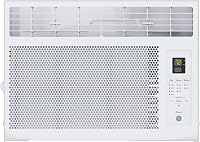
The GE 5,000 BTU window unit fits the smallest spaces in this group, with stated coverage up to 150 sq ft. It suits a compact bedroom, dorm room or office when the window opening meets its installation requirements; skip it for a larger or unusually sunny room.
The GE 6,000 BTU electronic window unit covers up to 250 sq ft and adds a remote, digital controls, timer and energy saver mode. It suits someone who wants scheduled operation and remote adjustments, but skip it if you need Wi-Fi control or cannot install a window unit.
The Black+Decker 10,000 BTU portable unit has stated coverage up to 450 sq ft. It works for someone who needs a movable unit with a remote and a window kit, but the exhaust hose requires a usable window and the unit occupies floor space.
The Black+Decker 14,000 BTU smart portable unit has a 14,000 BTU ASHRAE rating and a 10,200 BTU SACC rating, with stated coverage up to 700 sq ft. Wi-Fi app control and voice control suit a buyer who wants smart features; skip it if the room is small or you need a window-mounted appliance.
Portable units can show more than one BTU figure because rating standards differ. Compare the same kind of rating when choosing between models, and use the stated room coverage as a second check.
If a window unit is the right fit for a small space, see our window AC options for small rooms. For a larger space that calls for a portable setup, compare portable ACs for large rooms.
How do you choose between a window and portable AC?
Choose based on the cooling need, available window and space inside the room. A window unit mounts in the opening; a portable model sits indoors and sends hot air outside through a hose.
A window AC is a strong fit when you have a compatible window and want the unit outside your living area. Measure the opening and check installation requirements before buying.
A portable AC makes sense when a window unit is impractical or you want to move the unit between rooms. It still needs a window for its exhaust hose, and the unit takes up indoor floor space.
Use the same rating standard when comparing portable options with window models. Our portable AC versus window unit comparison lays out the installation trade-offs, while our inverter versus non-inverter guide covers a separate choice that can affect how an AC operates.
How should you set up and care for a room air conditioner?
Install the unit as its instructions require, and keep its airflow and filter clear. Good setup helps the AC work as intended and makes routine care easier.
For a portable unit, place it near a suitable window, connect the exhaust hose and fit the window kit so the opening is sealed around it. Follow the included instructions, keep the hose as straight as the setup allows, and avoid blocking the air outlet.
For a window unit, check that the opening meets the unit's width and height requirements before installation. Secure the unit and close gaps around the frame with the provided installation materials.
Clean a washable filter on the schedule in the owner's manual, and let it dry fully before putting it back. Keep furniture, curtains and other objects away from the air intake and outlet so airflow is not restricted.
Portable units may need water drainage in some conditions or modes. Check the manual for the model's drain guidance; our guides explain how to drain a portable AC and how to clean one.
What mistakes lead to the wrong BTU size?
The most common mistake is treating the area estimate as an exact answer. A good match also accounts for heat entering the room and whether the AC can be installed and vented correctly.
- Choosing by floor area alone: check sun, ceiling height, insulation, people and appliances.
- Buying the largest unit available: oversizing can leave the room cool but damp.
- Ignoring rating standards: portable ACs may show ASHRAE and SACC values, which are not interchangeable.
- Forgetting the window: verify the opening and installation method before choosing a window or portable model.
- Sizing for the whole home: estimate the space the unit can actually serve, based on doors and airflow.
If the room is open to several other areas, a small room estimate may not describe the whole cooling job. Consider a cooling-load calculation when the layout or heat conditions are unusual.
How many BTU per square foot should you choose?
Start near 20 BTU per square foot, then choose a model whose stated coverage fits the room and its heat load. Pick a window unit when its opening fits and you want the appliance mounted there; choose a portable unit when its hose setup and indoor footprint suit your room.
For the next step, compare options in our air conditioner sizing and power guide and use your measurements to narrow the range. The right answer comes from matching the room, rating method and installation, not from BTU per square foot alone.
Frequently asked questions
How many BTU per square foot should an air conditioner have?
About 20 BTU per square foot is a common starting estimate for a room with an 8 ft ceiling. Sun exposure, high ceilings, cooking, insulation and local climate can change the cooling load, so use the estimate to narrow choices, then check the unit's room guidance.
How many BTU do I need for a 12 x 12 room?
A 12 x 12 ft room has 144 sq ft. Multiplying by 20 gives an initial estimate of 2,880 BTU.
Compare units intended for a room near that size and account for sun, ceiling height and heat sources before choosing.
Can an air conditioner be too powerful for a room?
Yes. An oversized unit can cool the air quickly and shut off before removing enough moisture, which may leave the room feeling clammy.
Match capacity to the room and its conditions instead of choosing the largest unit available.
Does a portable air conditioner need more BTU than a window unit?
Compare the rating method as well as the number. Portable models may show both ASHRAE and SACC BTU figures, and SACC can be lower because it accounts for heat entering through the exhaust setup.
Should I size an air conditioner by room area alone?
No. Area is a useful starting point, but ceiling height, sun, insulation, people, cooking and climate also affect cooling needs.
Measure the room, then use the manufacturer's room guidance or a cooling-load calculation for an unusual space.